
A federal judge who spent weeks giving government lawyers the benefit of the doubt now wants an outside investigator to find out whether she was misled. On Saturday, U.S. District Judge Ana C. Reyes said she intends to appoint Jessie K. Liu, the former U.S. attorney for the District of Columbia, as a special master to examine whether Justice Department and Interior Department lawyers and officials violated ethics rules or misled the court in the fight over the redevelopment of East Potomac Golf Links, a public golf course on the Potomac River in Washington, according to The Associated Press and The Washington Post.
This is a story about a golf course, but the stakes are not golf. They are the duty of candor that every lawyer owes a court, and whether it holds when the client is the most powerful government in the country. No one has been found to have done anything wrong. The judge herself has said so. What is notable is that a court felt it had to ask.
What the judge ordered
The Epoch Times reported that Reyes’s Nov. 7 order says the court intends to appoint Liu, who served as U.S. attorney for D.C. from 2017 to 2020 during Trump’s first term. The inquiry would cover potential violations through Oct. 31. Liu was appointed to that post by Trump himself, which means the proposed investigator is a former official of the same president’s first administration.
At an Oct. 30 hearing, reported by The Washington Sun and NBC Washington, Reyes said she would open a formal inquiry. She listed what she wants examined, including whether the government held back notice of tree cutting “to intentionally evade judicial review,” whether lawyers told officials to leave details out of court filings, and whether lawyers were truthful when they said there were no plans to redesign the course. She said the inquiry does not mean the court has found misconduct: “That’s why we’re conducting an investigation.” The government has five business days to object to a special master, according to the Sun.
The timeline in the record
The reporting lays out a sequence worth setting down carefully.
- The Epoch Times said the project was set in motion in January 2026, and that the D.C. Preservation League and two golfers sued the Interior Department and National Park Service, arguing the plans violate environmental, historic-preservation and park laws.
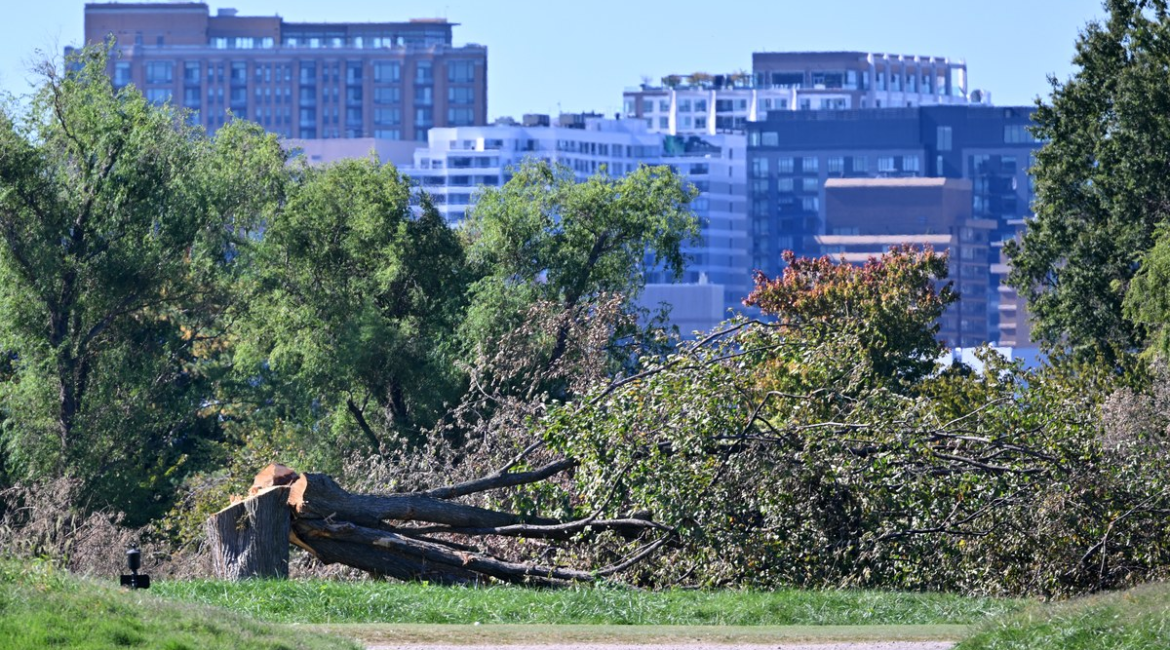
- On Oct. 10, the government cut down 430 trees, the Epoch Times reported. NBC Washington said agency lawyers had first described the work as maintenance. Reyes ordered a temporary halt to tree cutting on Oct. 13.
- On Oct. 16, the government told the court that “there is no final agency action” and that “at most … the President has given preliminary thought to” rebuilding the course.
- On Oct. 18, Trump posted a rendering on Truth Social with the Interior Department seal, announcing a plan developed with Interior Secretary Doug Burgum and architect Tom Fazio, and saying a 15-month restoration would start Nov. 15.
- The Washington Sun reported that at an Oct. 19 hearing, Associate Attorney General Stanley Woodward told the court there were no plans to close the course by Nov. 15.
- At the Oct. 30 hearing, Woodward told the judge that an Interior official had “put pen to paper” on a plan in recent weeks, according to the Sun, and that plans to close the park Nov. 15 had been in the works for weeks, per NBC Washington.
The Sun quoted the judge’s reaction: “Are you telling the court there’s been pen to paper for plans to redevelop the East Potomac golf course in the last two weeks, and no one, no one mentioned that on Oct. 19 in a seven-hour meeting?” When she asked what the president meant by his post, the Sun quoted Woodward as saying he did not know and, if he did, “I couldn’t talk about that,” and then invoking executive privilege. Reyes replied: “He posted it publicly!”
NBC Washington reported that Reyes read the D.C. bar’s rules to the government lawyers and noted that she had earlier rejected plaintiffs’ motions because she trusted the government’s attorneys. It also reported that the government told the court there is no budget for the project, a claim the judge questioned given how far along it was, and that the proposal was being submitted to the National Capital Planning Commission. The Sun said the government also tried to get the judge to remove herself from the case. We have not seen the government’s formal response to the special-master order, and Woodward and the Justice Department may dispute the judge’s characterization.
Why a conservative should care
Limited-government conservatives have good reasons to care about this regardless of the golf. First, the rule of law that binds a Democratic administration binds a Republican one. Courts rely on lawyers’ representations because they cannot investigate everything themselves; if those statements cannot be trusted, the whole system of judicial review loses its footing. Second, this is public land, and the plan’s cost and who will pay for it remain unanswered; the government told the court there is no budget. Third, a project announced by the president on social media and described in court as a “preliminary thought” is exactly the kind of gap between public statements and legal filings that invites suspicion.
There is also a defense worth stating fairly. The administration can argue that the president is entitled to announce ambitions, that agencies may plan while litigation proceeds, and that the tree work was part of an older beautification plan. A judge’s inquiry is not a verdict, and Reyes herself said the question remains open. If the special master finds the government’s lawyers were accurate, that will be worth reporting as plainly as any adverse finding.
What happens next
The next steps are procedural: whether the government objects to Liu’s appointment, whether the Nov. 15 closing date holds, and how the court rules on the underlying claims. A special master could take testimony, and the Sun reported the process would likely include an evidentiary hearing and possible sanctions if misconduct is found. Those are possibilities, not predictions.
For readers, the takeaway is simple. Accountability for government lawyers is not an exotic idea; it is the ordinary price of appearing before a federal court. When a judge says she needs an independent person to determine whether she was told the full story, the public deserves an answer, whichever way it comes out.
This account relies on reporting by The Associated Press, The Washington Post, NBC Washington, The Washington Sun and The Epoch Times (Oct. 30–Nov. 8, 2026). Allegations of misrepresentation are the subject of the court’s inquiry; none has been proven.



