
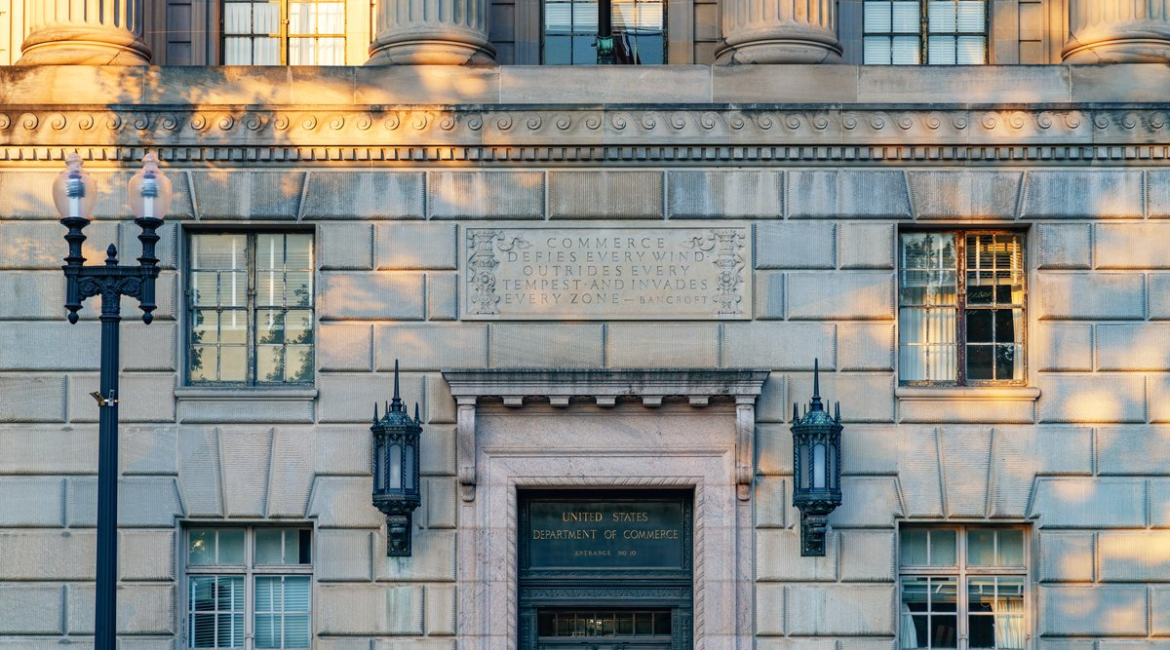
Export controls on advanced American chips are supposed to be among the most serious national security laws on the books. They exist to keep the processors that power artificial intelligence out of the hands of the Chinese Communist Party’s military and intelligence services. That is why a growing set of questions about how the Commerce Department stepped back from a chip-smuggling investigation deserves attention from everyone who cares about both China and clean government.
Over the past 48 hours, news reports have described how a federal probe into a Singapore company accused of diverting Nvidia chips to China was handed from Commerce to the Justice Department after an Nvidia representative contacted Commerce investigators. On Wednesday morning, Semafor reported that a senator is now formally demanding answers. No one has been charged with wrongdoing in connection with the handling of the probe, and the officials and companies involved defend their conduct. But the episode raises exactly the kind of process questions that oversight is for.
What has been reported
The company at the center is Megaspeed International, a Singapore-based data center firm that has been investigated for months over whether it funneled advanced Nvidia chips to China in violation of U.S. export controls, according to Export Compliance Daily, summarizing a New York Times report. We have found no public report that Megaspeed has been charged, and the company did not respond to the Associated Press’s request for comment.
The case was being investigated jointly by the Justice Department and Commerce’s Bureau of Industry and Security (BIS), which enforces export controls. According to the Times account as summarized by Export Compliance Daily:
- In August 2025, an Nvidia official, whom the Times identified as general counsel Tim Teter, contacted BIS agents and asked for a meeting. The agents declined.
- The Nvidia official then told the agents that BIS Undersecretary Jeffrey Kessler, the agency’s politically appointed head, had said it was okay for the company to speak with them.
- The agents were “alarmed,” the Times reported, with some believing the contact risked “violating government procedure and potentially tainting the case.” They held meetings and disclosed the incident to other enforcement agencies.
- The Justice Department later asked Commerce to pause its work on the case. The Times said it was not clear whether other factors contributed to that decision.
NBC News separately reported, citing a person familiar with the matter, that the Justice Department asked Commerce to pause its part of the inquiry after an Nvidia representative reached out to Commerce investigators.
Why does that matter? The Times reported that the political head of BIS is normally kept separate from the details of enforcement cases because he may later have to rule on them as a “neutral arbiter.” Officials told the paper that Kessler, perhaps inadvertently, had “opened himself to accusations of undue influence,” and that his contacts with Nvidia could be subject to discovery or subpoena if the government brings a case against Megaspeed.
What the parties say
Commerce rejects any suggestion of interference. “BIS conducts all enforcement strictly by the book,” a department spokesperson said, according to Export Compliance Daily. “BIS enforces aggressively across the board, including with respect to chip smuggling, and enforcement is at an all-time high.” The department did not answer questions about whether Kessler’s contact is under review or where the Megaspeed case stands.
Nvidia told the Times that it speaks with U.S. officials “to answer their questions, provide information we have gathered from the field, request their guidance and instructions,” and that it works “to help government and our partners halt any would-be smugglers while serving the critical market of lawful customers.”
Why the story exploded now
The probe drew sudden scrutiny because of Nvidia’s chief executive. Over the weekend, Jensen Huang acknowledged an affair with a business executive, and Nvidia’s board announced an independent investigation into reports he was the “target of a foreign intelligence effort,” the Associated Press reported. The New York Times reported that the woman, a former Megaspeed executive named Alice Huang (no relation), is believed by U.S. intelligence to have been gathering information for Beijing. She has not been charged, and China’s foreign ministry called the spying claim “unsubstantiated” and “nothing but smears against China.”
Jensen Huang said he supports the board’s investigation and will “cooperate fully.” The board said it has no reason to believe national security secrets were compromised, Axios reported.
Axios also reported Tuesday that Commerce Secretary Howard Lutnick was sent a highly classified memo, drafted under Secretary of State Marco Rubio’s supervision, warning about the relationship before President Trump’s May 13-15 trip to China. On May 14, Reuters reported that Commerce had cleared about 10 Chinese companies to buy Nvidia’s H200 chips, Axios noted, though some export approvals predated the warning and it is unclear how many sales followed. Commerce did not comment to Axios.
The president has backed Huang. “I know the FBI is looking into it in terms of something else, and I think that he’ll be in good shape,” Trump said Monday, according to the AP, adding that Huang told him “he had absolutely no idea that the person in question was a spy.” Asked about the memo, Trump said it was possible he had been shown it but “certainly, it didn’t make much of an impact on me,” Axios reported.
Congress wants answers
Sen. Michael Bennet, D-Colo., wrote to the State, Commerce and Justice departments and the director of national intelligence asking for an update on the Megaspeed investigation, calling the effort “crucial and time-sensitive,” Semafor reported. He also asked them to consider “specific punitive measures against Megaspeed, as well as stronger approaches to export controls and enforcement.” Semafor said Commerce is reportedly resisting other agencies’ push to add Megaspeed to its trade blacklist.
The top Democrats on the House Foreign Affairs Committee have demanded that Lutnick explain the department’s chip approvals, and lawmakers in both parties have sought closed-door testimony from Jensen Huang next week, according to Axios.
Why conservatives should care
It would be easy to treat this as a partisan pile-on, since most of the loudest letters so far come from Democrats. That would be a mistake. Being tough on Beijing’s access to American technology has been a conservative cause for years, and export-control enforcement only works if companies, foreign buyers and China itself believe it is applied without favoritism. If a well-connected company can get a political appointee’s blessing to approach the agents investigating its customer, every smaller exporter and every smuggler learns the wrong lesson, whether or not anything improper was intended.
Nothing reported so far proves that anyone broke the law or that the Megaspeed case was steered. That is exactly why a credible, independent review is the right next step, not a reason to skip one.
What should happen next
- An inspector general review. Commerce’s inspector general should examine how the August 2025 contact happened, what Kessler discussed with Nvidia and whether department rules were followed, and report to Congress.
- A clear firewall rule. Political appointees who may decide export-control cases should be barred in writing from authorizing or encouraging private contact with enforcement agents, and any such contact should be logged and reported to the agency’s ethics office.
- A status report on Megaspeed. Without compromising an open case, the Justice Department should tell the relevant committees whether the investigation is active.
- Bipartisan oversight. Republicans on the China and foreign affairs committees should join the inquiries rather than leave them to Democrats. National security is not a partisan question.
Trump is scheduled to meet Chinese leader Xi Jinping next week at the Asia-Pacific Economic Cooperation summit in Shenzhen, the AP reported. Washington’s leverage depends on Beijing believing that American export rules mean what they say. Getting clear, public answers on Megaspeed is one way to show that they do.
Sources: Semafor (Nov. 11, 2026); Export Compliance Daily (Nov. 10, 2026), summarizing The New York Times; NBC News (Nov. 9, 2026); Associated Press via The Philadelphia Inquirer (Nov. 9, 2026); Axios (Nov. 10, 2026). The allegations that Alice Huang is a Chinese intelligence agent are based on reported U.S. intelligence assessments; she has not been charged and China denies them. No one has been charged in connection with the handling of the Megaspeed probe.




[…] covered the earlier reports that Commerce paused its Megaspeed probe on Nov. 11. The new issue here is the personal financial […]