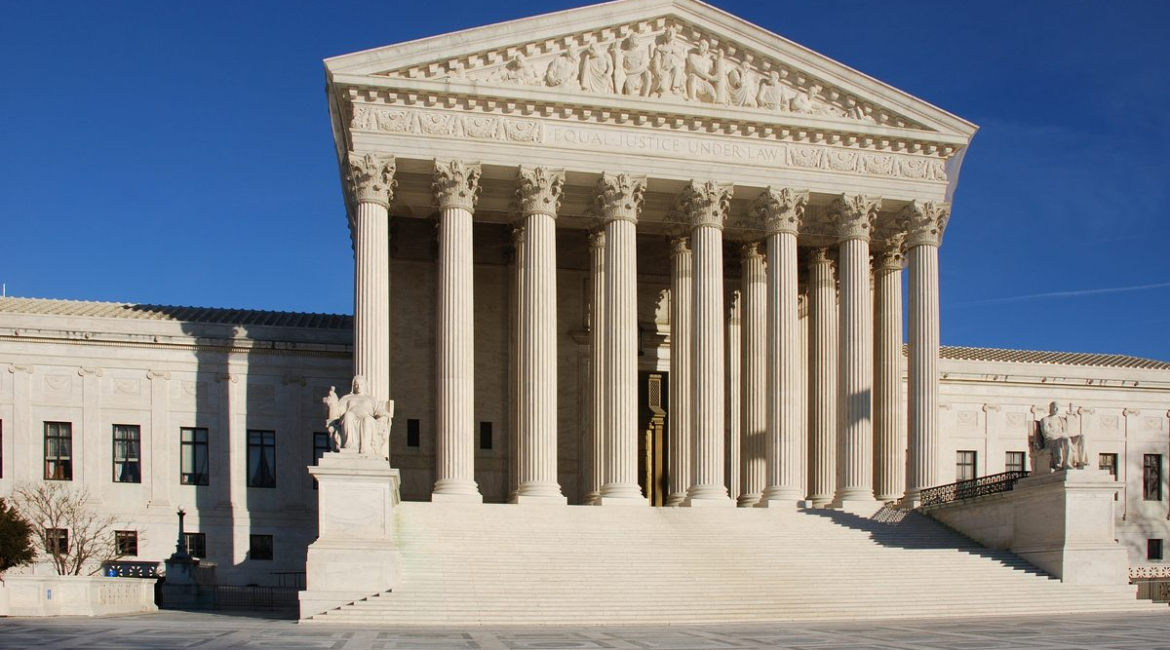
The Supreme Court will decide whether a president can shut off access to asylum at the southern border by proclamation. On Friday the justices agreed to hear Mullin v. Refugee and Immigrant Center for Education and Legal Services, the administration’s appeal of lower-court rulings that struck down the order President Trump signed on his first day back in office. Arguments are likely next spring, with a decision expected by the end of the term in June, SCOTUSblog reported.
The policy stays in effect while the case is pending. That means the outcome will not change what happens at the border tomorrow. It will decide something more lasting: whether the border policy that has coincided with the lowest crossings on record rests on solid legal ground, or whether it needs Congress to write it into law.
What the order does
On Jan. 20, 2025, Trump issued Proclamation 10888, which declared that “an invasion is ongoing at the southern border” and suspended the entry of migrants covered by it. The Department of Homeland Security then issued guidance barring those migrants from applying for asylum and allowing them to be removed quickly, without some of the procedural steps federal immigration law normally requires.
The challengers are 13 people who say they were persecuted or tortured in their home countries, along with three immigration nonprofits, represented by the ACLU and allied groups. U.S. District Judge Randolph Moss in Washington certified a class covering migrants who are or would be subject to the proclamation, held the DHS guidance unlawful and barred officials from carrying out those parts of the policy.
A panel of the U.S. Court of Appeals for the D.C. Circuit largely agreed. Judge J. Michelle Childs, joined by Judge Cornelia Pillard, wrote that the “text, structure, and history” of immigration law show that when Congress gave presidents power to suspend entry, it “did not intend to grant the Executive the expansive removal authority it asserts.” Judge Justin Walker dissented in part. He argued the president has discretion to deny all asylum applications and can skip the application process on that basis, but he agreed the government “cannot remove aliens to countries where they will be persecuted.” The appeals court kept its ruling on hold while the government appealed, so the restrictions have remained in place.
What the justices will decide
The administration asked the court three questions. The justices agreed to take two:
- Whether the proclamation and its implementing guidance, which suspended entry and blocked access to asylum and similar protections, are lawful.
- Whether a federal statute, 8 U.S.C. 1252(f)(1), bars the kind of classwide relief Judge Moss entered.
They declined a third question about whether the class itself was properly defined.
Solicitor General D. John Sauer told the court the border had been “overwhelmed by an ungovernable influx of millions of aliens,” and that suspending illegal entry and access to asylum is “the most important and effective” piece of the president’s response. The proclamation, he wrote, “rests on a commonsense understanding of the President’s inherent and delegated powers to exclude aliens.” In the government’s petition, quoted by Roll Call, the administration argued that asylum “is a purely discretionary benefit” and that the lower court’s insistence on letting migrants file “futile asylum applications elevates empty procedures over substance.”
The challengers counter that the president “may not invent by fiat a new removal system that eviscerates the protections Congress mandated by statute.” They point to the asylum law’s statement that noncitizens “may apply” for asylum regardless of how they entered, and they argue the statute Trump relied on governs who may enter, not how people already here are removed. They also dispute the emergency rationale, writing that by January 2025, apprehensions “had returned to historically routine levels, down over 90 percent from their peak.”
The border numbers
Both sides will lean on the data. According to U.S. Customs and Border Protection, Border Patrol recorded 98,708 apprehensions at the southwest border in fiscal 2026, which ended Sept. 30, the lowest in the agency’s history and about 95% below the annual average of more than 1.8 million under the previous administration. Nationwide encounters totaled 379,243, and CBP says Border Patrol released no one into the country during the fiscal year. Those are preliminary figures from the agency, and they reflect the full range of enforcement measures, not only the asylum order.
The administration says the results prove the policy works. The challengers say the decline began before the proclamation and that Congress, not the president, should supply any new tools. The court’s job is narrower than either argument: to decide what the statutes allow.
Why this case matters beyond the border
The second question may prove as important as the first. Section 1252(f)(1) limits the power of lower courts to “enjoin or restrain” the operation of certain immigration laws, except for individual cases. The government says it bars the classwide order here. The challengers say it does not apply because the proclamation relies on other statutes. A ruling for the government would sharply limit the ability of a single district judge to block a nationwide immigration policy for a whole class of people, continuing the court’s recent skepticism of sweeping lower-court orders.
The case also joins a crowded immigration docket. The justices have already agreed to review the administration’s practice of deporting people to countries not named in their removal orders and its policy of detaining many immigrants without bond hearings. Last term, Roll Call noted, the court sided with the government on a separate first-term policy that allowed officials to stop asylum seekers before they reached the border, and a loss in this case could push the administration back toward that approach.
Our view
A secure border is a legitimate and urgent national interest. The record low crossings of the past year matter, and so does the end of mass releases into the interior. Asylum also has real limits in law: it is discretionary, and Congress never intended it to become a routine path around the immigration system for people who do not qualify.
But conservatives should want border policy that lasts beyond any one administration, and that means it has to stand on statute, not just on a proclamation and an emergency label. Even Judge Walker, a Trump appointee who largely sided with the government, drew a line at removing people to countries where they would face persecution. That line reflects a treaty obligation and a long American tradition, and it can be honored while still turning away claims that do not qualify.
The cleanest answer is the one the challengers themselves invoke: if the executive branch needs new tools, Congress should provide them. Republicans control Congress only until January, when Democrats take over both chambers. Lawmakers in both parties who want order at the border to survive the next election, and the next president, should be working now on bipartisan legislation that sets clear rules for asylum screening, fast decisions and swift removal of those who do not qualify, while keeping the protection against sending people back to persecution. A Supreme Court victory would be welcome. A law would be better.
Sources: Supreme Court order list and questions presented in No. 26-239 (Nov. 13, 2026); SCOTUSblog (Amy Howe, Nov. 13, 2026); Roll Call (Nov. 13, 2026); Associated Press; U.S. Customs and Border Protection fiscal 2026 preliminary data release. Quotations from the parties are from their Supreme Court filings as reported by SCOTUSblog and Roll Call. “Our view” is this publication’s opinion.