Voters spoke on Nov. 3, and in January Democrats will control both the House and the Senate. Until then, the outgoing Congress still has the power to pass laws. Senate Republicans have said openly that they intend to use that time. After the election, they adopted a conference resolution, obtained by Fox News Digital, pledging to “maximize the 54 days we have with congressional majorities” and to “do everything humanly possible to pass a reconciliation bill before Jan. 3.”
Many conservatives will cheer. They should first remember December 2022, when the party roles were reversed. In both cases, members who had just been voted out were still casting votes on major legislation. A self-governing republic should not rely on whichever party happens to hold power in the weeks after an election. It needs rules that apply no matter who is in charge.
This is not about whether lame-duck sessions should exist at all. Sometimes Congress has to keep the government funded, finish a defense bill or respond to an emergency. The problem is the use of the post-election weeks as a final, low-accountability window to pass legislation and regulations that could not have survived before the election. Here are six ways to fix it.
How we got here
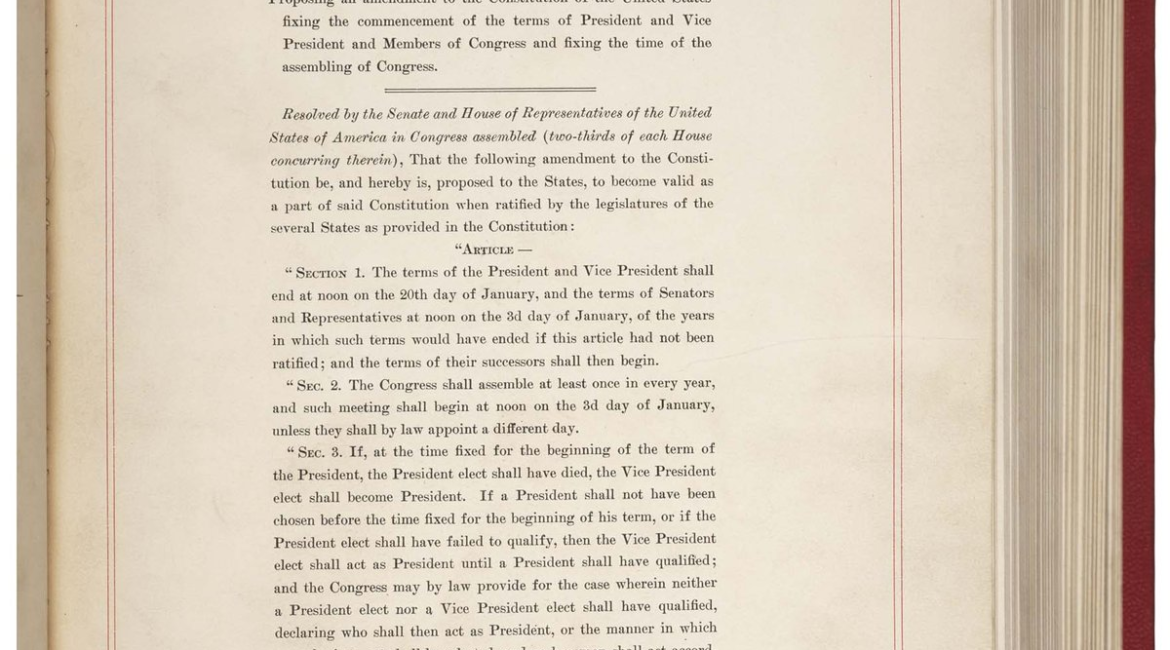
The Twentieth Amendment, ratified in 1933, was meant to address this problem. Before it, a newly elected Congress did not begin its term until March 4. Every Congress’s final session met after its replacement had already been chosen. The amendment moved the start of congressional terms to Jan. 3. According to the Congressional Research Service, one of its purposes was to end the automatic lame-duck session.
It did not stop the practice. In its latest report on the subject, CRS counts 25 lame-duck sessions since 1935. From 1935 through 1998, they took place in 12 of 32 Congresses. Since 2000, there has been one after every election, and in eight of the past nine Congresses the session ran into the new year. CRS notes that most recent lame ducks have centered on appropriations and program authorizations, meaning the spending decisions Congress failed to finish before the voters weighed in.
The results are familiar. In 2022, the outgoing Democratic Congress passed a $1.7 trillion, 4,155-page omnibus. It combined all 12 annual spending bills with aid to Ukraine and a long list of unrelated provisions, and the Senate passed it 68-29 on Dec. 22. The text had been released in the early hours of Dec. 20. In 2024, a lame-duck stopgap deal fell apart after President-elect Trump and Vice President-elect Vance opposed it. The replacement failed in the House 174-235, and a third version was signed into law on Dec. 21, CRS reports. Neither party looks good in either episode.
The executive branch has the same problem. Researchers call it “midnight regulation.” Patrick McLaughlin of the Mercatus Center found that “when an administration’s time is almost up, submissions of economically significant regulations nearly double.” The rush also speeds up White House review: each additional major rule submitted cut average review time for all rules by about two-thirds of a day. A separate study by Jerry Ellig, McLaughlin and John Morrall found that the Bush administration’s midnight rules, issued between Election Day and Inauguration Day, “tended to have lower-quality analysis.” This happens under presidents of both parties.
Six fixes
1. Limit post-election floor action to what is truly necessary. Each chamber writes its own rules and can change them by majority vote at the start of a new Congress. The House and Senate should adopt standing rules that, between Election Day and Jan. 3, allow floor votes only on continuing resolutions, emergency and disaster appropriations, conference agreements on bills both chambers passed before the election, and measures responding to a declared national emergency. The idea has been around for years. After the 2010 lame duck, then-Rep. Lynn Jenkins, a Kansas Republican, pushed legislation to end lame-duck sessions except in a national emergency, with unfinished spending carried forward by stopgap until the new Congress took over. “Every Congress has 22 months before an election to do their job,” she said.
2. Stop the year-end omnibus. Most lame-duck spending sprees happen because appropriations were not finished by Oct. 1. If an automatic continuing resolution took effect whenever spending bills lapse, at the prior year’s levels and with no new programs, the December “pass it or shut it down” standoff would go away. The newly elected Congress would then write the full-year bills. Lame-duck omnibuses depend on leaders using the threat of a shutdown. Removing that threat removes much of the reason for them.
3. Require more reading time when it matters most. The House already has a rule requiring that bill text be available for 72 hours before a vote. For any lame-duck bill longer than 500 pages or costing more than $100 billion, both chambers should require at least seven days, a posted Congressional Budget Office estimate, and a searchable section-by-section summary before final passage. A bill of 4,155 pages released in the middle of the night and passed within days does not meet any reasonable standard of deliberation.
4. Pass the Midnight Rules Relief Act. Under the Congressional Review Act, Congress can overturn recent regulations, but only one rule per resolution. That makes it impractical to review a flood of last-minute rules. The Midnight Rules Relief Act would allow a single resolution to cover multiple rules submitted late in a president’s final year. The House passed its version, H.R. 77, 212-208 on Feb. 12, 2025. The Senate version, S. 164, sponsored by Sen. Ron Johnson (R-Wis.), was reported by the Homeland Security and Governmental Affairs Committee and placed on the Senate calendar on Sept. 14, 2026, according to congressional records. It has not received a floor vote. Because it is a procedural tool, it will help whichever party next takes the White House from the other.
5. Delay midnight rules from taking effect. Congress should also address the cause and not only the damage. Any significant rule finalized by an outgoing administration after Election Day should not take effect until 90 days after the next inauguration, unless the agency certifies an emergency or a court deadline and explains it in writing. That gives the new administration and Congress a fair chance to review the rule without forcing them through the slow process of repealing it. Mercatus scholars Jerry Brito and Veronique de Rugy proposed an alternative in 2008: capping how many economically significant rules can go through review in a given period. Either approach would slow the rush.
6. Require recorded votes on every lame-duck bill. Departing members cannot be held accountable at the ballot box. The least the public is owed is a clear record of how they voted. No significant spending or policy bill should pass by voice vote or unanimous consent after Election Day. Every member should be on the record. The longer-term solution is a constitutional amendment allowing post-election sessions only in a declared emergency, but recorded votes can begin with the next rules package.
What this does not cover
These reforms apply to legislation and regulation, not confirmations. The Senate’s duty to advise and consent does not pause after an election. CRS notes that 19 judges were confirmed in the 2010 lame duck, and Fox News reported earlier this month that 23 judicial nominees were pending. Senators can argue about how quickly to move nominees. The constitutional calendar, however, gives the current Senate that power until Jan. 3.
The bottom line
Conservatives believe government should answer to the governed. A Congress that has just been voted out, passing thousand-page bills before Christmas, and an outgoing administration rushing out rules on its way out the door both work against that principle. These problems have occurred under both parties. Fixing them now, while each party remembers being on the receiving end, is the most realistic chance of getting reforms that last.
Sources: Congressional Research Service, “Lame Duck Sessions of Congress, 1935-2024” (R45154, updated Sept. 15, 2026); Roll Call (Dec. 22, 2022); Fox News Digital; The Hill; Office of the Clerk, U.S. House of Representatives (Roll Call 41, 2025); Congress.gov records for S. 164 via LegiList; Mercatus Center research on midnight regulations (McLaughlin 2008, 2011; Ellig, McLaughlin and Morrall 2012; Brito and de Rugy 2008). The page and dollar thresholds in Fix 3 are this magazine’s proposal, not existing law.