For one day, the war premium came out of oil. Crude fell about 9% on Wednesday, the Dow had one of the biggest point gains in its history, and Treasury yields fell to levels not seen in more than a year. But two reports released the same morning, on private hiring and the service economy, point the other way: the economy is still running hot enough that markets now see roughly four-in-five odds that the Federal Reserve raises rates in December.
Both things are true at once. Here is what moved, why it moved, and what it means for families paying for gas, groceries and mortgages.
The oil drop, by the numbers
Global benchmark Brent crude fell nearly 9% to settle at $94.62 a barrel, Reuters reported. U.S. benchmark West Texas Intermediate fell nearly 8% to about $88.55, its lowest level in nearly two months, according to Investopedia.
The trigger was political. Vice President JD Vance wrote on X Wednesday morning that “the reason we lost is the war,” and President Trump later called that assessment “largely true.” The BBC tied the oil slide directly to Vance’s comments, and said markets read the post-election landscape as lowering the chance of a major escalation with Iran. Reuters quoted Bell Curve Trading’s Bill Strazzullo: “The market is responding to the fact that we’re going to have at least some oversight.”
Keep it in perspective. Even after the drop, the BBC noted, Brent is still almost 50% higher than a year ago. One good day does not end a war, and the Strait of Hormuz has not reopened.
What it means at the pump
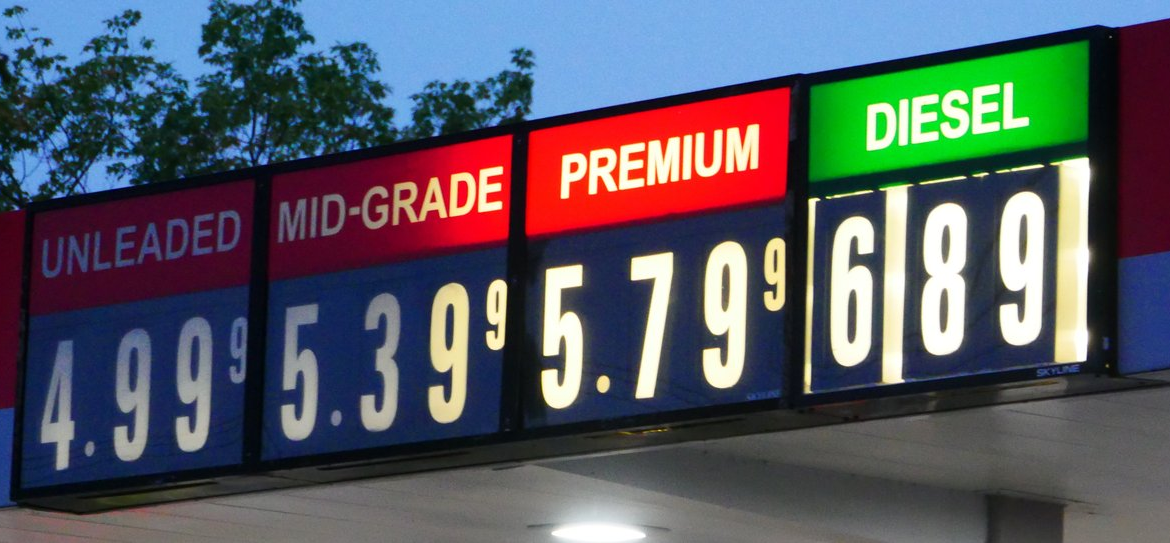
Gas prices were already falling before Wednesday. AAA’s national average for regular was $4.12 a gallon on Nov. 4, down 12 cents in a week and 24 cents in a month, al.com reported from AAA data. Prices fell in all 50 states that day. A year ago, drivers paid $3.05.
Diesel is the bigger problem for the economy. The national average was $6.27 a gallon on Nov. 4, compared with $3.69 a year ago. Diesel moves the trucks that stock grocery shelves, so it takes longer for relief at the wellhead to reach prices in the store.
Stocks: a rally with a rotation inside it
The Dow Jones Industrial Average jumped 3.03%, or 1,569 points. Investopedia said it was the fifth-largest one-day point gain in the index’s history. The S&P 500 rose 1.58% and the Nasdaq Composite 1.44%. Microsoft gained 7%, Amazon 6% and Apple 5%. 3M led the Dow with a gain of more than 9%.
But the rally was not across the board. Investors are betting a Democratic Congress will bring more scrutiny of artificial intelligence and data-center buildouts. Nvidia fell 3%, memory makers Micron and Sandisk each fell more than 7%, and CoreWeave dropped 10%. Defense stocks also fell: Lockheed Martin lost 7% and Northrop Grumman 4.5%.
That rotation continued Thursday morning. FXStreet reported Dow futures up about 0.5% in European hours while Nasdaq 100 futures were down about 0.7%, as money moved out of technology and into other sectors.
Bonds and the dollar
The 10-year Treasury yield fell 6.6 basis points to 4.88%, per Reuters. Investopedia put Tuesday’s close at 4.97% and said the yield is near its lowest level in more than a year. That matters for anyone shopping for a home, because mortgage rates track the 10-year. The dollar index fell 0.23%, gold rose 3.49% to $4,065.80 an ounce, and bitcoin gained 3% to about $80,165.
The catch: hiring and services are still running hot
Wednesday’s oil news came on the same day as two reports showing more strength than expected.
Private payrolls. Private employers added 86,000 jobs in October, according to the ADP National Employment Report. FXStreet said economists had expected about 69,000. September was revised down from 90,000 to 86,000. Trade, transportation and utilities added 39,000 jobs, education and health services 28,000, and leisure and hospitality 19,000. Professional and business services lost 27,000, the third straight monthly decline. Base pay was up 3.2% from a year earlier; job-changers got 4.8%. “Earnings growth for these workers hit its fastest pace since March 2024,” ADP chief economist Nela Richardson said, referring to job-changers’ total earnings.
Services. The ISM Services PMI registered 54.5 in October, down from 54.9 but in expansion for the 28th straight month. Economists polled by Reuters had expected 54.8. The prices index was 73.0, above 70 for the seventh time in eight months. No commodity was reported down in price, and fuel was reported up for the ninth month in a row.
The most important line came from ISM survey chair Steve Miller. Many respondents said they have not yet seen the full impact of higher costs, or have not passed them on to customers. “This indicates that more pricing pressure is on the way if oil and tariff cost impacts are not mitigated, even if they do not increase from current levels,” he wrote.
That is the problem in one sentence. Even if oil stays near $90, costs already in the pipeline have not yet reached consumers.
Why a December rate hike is still on the table
The Federal Reserve held its benchmark rate at 3.75% to 4.00% on Oct. 28, but two policymakers, Lisa Cook and Beth Hammack, dissented in favor of an immediate quarter-point hike, according to the Fed’s statement. The statement said plainly: “Inflation remains elevated.” Consumer prices rose 3.7% in the year to September, the BBC reported.
After Wednesday’s data, FXStreet said the CME FedWatch Tool put the probability of a December hike at nearly 82%. The Fed’s next meeting is Dec. 8-9. There is no November meeting.
Household finances are under strain. Reuters noted that inflation-adjusted disposable income fell in September and the saving rate is at a four-year low of 3.8%.
What to watch next
- Thursday: Weekly initial jobless claims, plus earnings from ConocoPhillips, Kimberly-Clark and Airbnb.
- Friday: The government’s October jobs report. Economists polled by Reuters expect 65,000 jobs, after 29,000 in September, with unemployment unchanged at 4.2%.
- Oil: Whether Brent holds below $100. Qatar-mediated talks are ongoing, but reports of possible new U.S. strikes have not gone away.
The bottom line
Wednesday showed how much of today’s inflation comes from one policy choice. A single political statement took nearly 9% off the price of oil in a few hours. That is good news for drivers, but it is not a strategy. A strong job market and stubborn service-sector prices mean the Fed may still raise rates just as families get some relief at the pump.
Conservatives have long argued that sound money and stable prices come first, and that Washington should not make the Fed’s job harder. The best thing policymakers in both parties can do now is avoid adding new price shocks, through energy, tariffs or spending, while the Fed tries to finish the job.
Market figures are from Wednesday’s close unless noted. Thursday’s jobless claims and Friday’s payroll report had not been released when this was written.