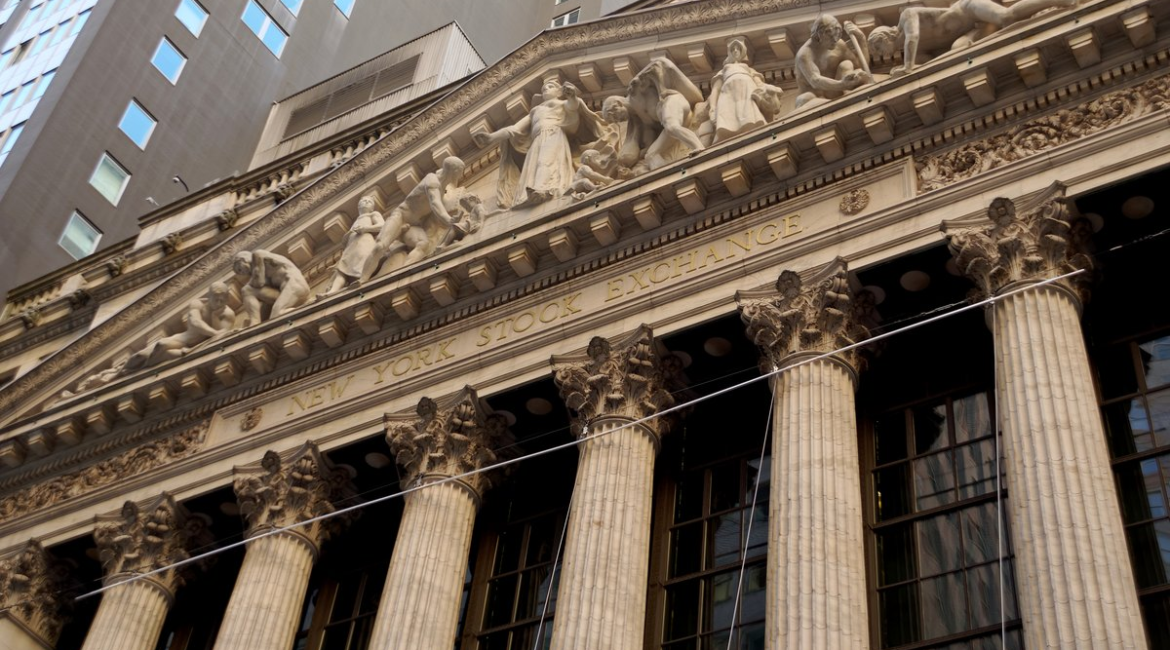
Wall Street just had its best day in seven months, and a Federal Reserve governor answered it the next morning with a warning that the central bank may need to raise rates faster than markets expect. That pairing, a powerful relief rally on Monday followed by a hawkish signal on Tuesday, is the most important economic story of the last 24 hours. It frames the October consumer price report, due from the Bureau of Labor Statistics at 8:30 a.m. Eastern on Tuesday, and it tells households something simple: lower oil prices are helping, but cheaper money is not on the way.
Monday: the rebound
According to CNBC, the Dow Jones Industrial Average rose 1,104.02 points, or 2.15%, to 52,389.75 on Monday. The S&P 500 gained 2.35% to 7,549.94, its best day since April 8, and the Nasdaq Composite climbed 2.74% to 25,253.14. The Dow is now back above its Election Day close; the S&P 500 and Nasdaq are still slightly below theirs.
The rally was broad. CNBC said that in afternoon trading every S&P 500 sector except energy was higher, led by industrials, up 4.2%. Chip stocks that had been punished last week came roaring back: Advanced Micro Devices jumped 13% and Broadcom nearly 9%, and the iShares Semiconductor ETF, which fell about 13% last week, rose more than 7%. Nvidia was the exception, closing down about 4% after its board opened an investigation involving CEO Jensen Huang. Reuters said Nvidia touched a seven-month low before rebounding about 1.3% in Tuesday’s premarket.
Oil is doing the heavy lifting
The biggest single driver was oil. CNBC said U.S. West Texas Intermediate crude fell 4.38% Monday to settle at $86.85 a barrel and Brent slid 5.85% to $92.57. The slide continued overnight after President Trump said the Iran war “militarily is effectively over.” Bloomberg reported Tuesday morning that Brent fell 2.9% to $89.88, below $90 for the first time since August.
That matters well beyond the gas pump. Energy has been a main channel through which the war reached American wallets, and a falling oil price eases pressure on shipping, airfares and manufacturing costs. It is also the main reason economists expect a softer inflation report. A Reuters survey expects October CPI to rise 0.3% after September’s 0.6% jump, and Yahoo Finance reported forecasts for core inflation, excluding food and energy, to tick down to 0.2% for the month.
Tuesday: Waller says “let’s just say it”
Then came the Fed. Speaking in London hours before the CPI release, Governor Christopher Waller laid out his case in a speech posted by the Federal Reserve. “Let’s just say it. September’s inflation data were bad. There was no silver lining,” he said. He noted that the Fed’s preferred measure, personal consumption expenditures inflation, rose 0.5% in September and 3.7% over 12 months, with core PCE up 3.1%, and that more than 70% of core PCE service components rose by more than 3% over the year.
Waller said that even if October inflation improves, as he expects, he would “still support a 25 basis point increase” at the Fed’s December meeting. And he went further: if core CPI comes in “around 0.3 percent or even higher,” a 50 basis point hike “should be considered,” because “hiking only 25 basis points would put our credibility at risk, a risk I am not eager to take.”
He also gave a reason that oil relief may not last. Waller said insurance and ship-to-ship transfers needed to move tankers through the Strait of Hormuz are reportedly adding $20 to $30 a barrel to oil prices, that diesel prices are constrained by limited refining capacity, and that new Fed staff research suggests energy shocks may pass through to core inflation more than in the past, possibly “well into 2027.”
The bond market listened. Bloomberg said two-year Treasury yields rose four basis points as traders moved to fully price in a December increase, and the 10-year yield was little changed at 4.88%. Reuters reported that the CME FedWatch tool showed an 82.2% chance of a hike next month, up from 74% a week earlier, and that the two-year yield stood at 4.58%. Stock futures were mixed: Yahoo Finance said Dow futures were up about 0.5% and S&P 500 futures up 0.2%, while Nasdaq-100 contracts slipped.
A strong economy with a weak spot
Waller’s speech is a useful snapshot of an economy that is running hot rather than cold. He cited the initial estimate of 3.4% third-quarter GDP growth, October payroll gains of 165,000 and an unemployment rate of 4.1%. But he also flagged a “low hire, low fire” labor market in which young workers and the long-term unemployed are struggling. He said the share of unemployed people looking for work for more than six months “is now quite elevated for a period of economic expansion.” In other words, the jobs numbers look solid, but it is harder than it should be to get hired if you are out of work.
For conservatives, Waller’s argument should resonate. A central bank that promises to fight inflation and then flinches loses the credibility that keeps long-term interest rates, and mortgage rates, in check. The cost of that lost credibility is paid by savers, retirees on fixed incomes and young families, the people with the least room to absorb higher prices. Stable money is not a Wall Street luxury; it is a Main Street necessity.
What to watch next
The CPI release is the first test. Waller himself drew the line: core inflation of 0.3% or more would strengthen the case for a half-point hike. After the close, CoreWeave reports earnings, which Reuters described as a barometer of investor anxiety over AI. Bloomberg said Anthropic may begin formally marketing its initial public offering as soon as Tuesday, another test of investor appetite for AI. CNBC noted Cisco and Applied Materials report later this week, and the producer price index arrives Friday.
The bottom line
Monday’s rally showed how much good news cheaper oil can deliver, and how quickly investors will buy back into a beaten-down tech sector. Tuesday’s speech showed the limit: at least one Fed governor believes inflation is broad enough that falling oil will not be enough by itself. If the CPI cooperates, December’s hike may be a quarter point and markets can breathe. If it does not, the conversation shifts to a half point, and the post-election recovery in stocks will be tested again.
Written before the 8:30 a.m. ET release of October CPI on Nov. 10, 2026; forecasts cited are estimates, not results. Market data are from CNBC, Bloomberg via swissinfo, Reuters via StreetInsider and Business Standard, and Yahoo Finance. Waller’s remarks are from his Nov. 10 speech as posted by the Federal Reserve Board; he said the views are his own.