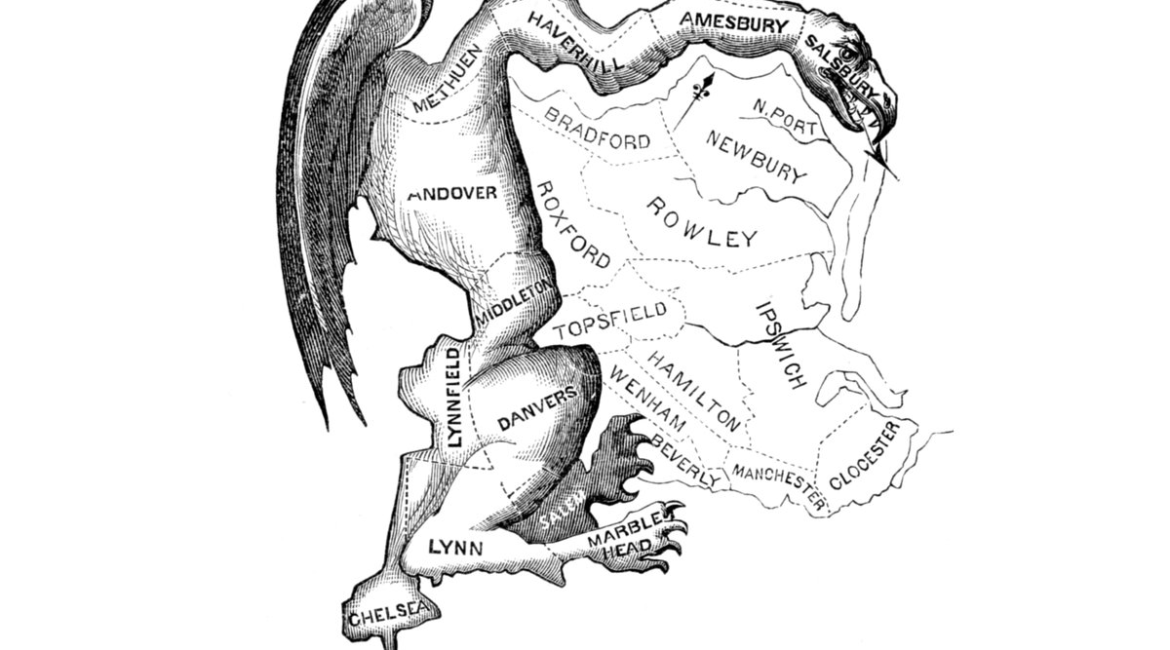
In 1812, a Boston newspaper published a cartoon of a Massachusetts state Senate district drawn to help Gov. Elbridge Gerry’s party. Its shape looked like a salamander, and the paper called it the “Gerry-mander.” More than two centuries later, the country has just had the largest round of mid-decade map-drawing in its modern history, and it didn’t work well for the party that started it.
That outcome gives both parties an opening to agree on rules before the next round starts. After the 2026 midterms, each side has reasons to accept limits on map-drawing, as long as both sides accept them at the same time.
What happened in the 2025–26 redistricting fight
Mid-decade redistricting used to be rare. A Pew Research Center analysis found that from 1970 until last year, only two states, Texas in 2003 and Georgia in 2005, voluntarily redrew congressional maps between censuses for partisan advantage. Pew found that 36 of 40 mid-cycle changes since 1970 were ordered or imposed by courts.
That changed in July 2025, when Texas redrew its map at President Trump’s urging to target five Democratic seats. Missouri, North Carolina and Ohio followed. California voters answered with Proposition 50, which set aside the state’s independent commission to target five Republican seats. Virginia Democrats passed a similar amendment, but the state Supreme Court voided it 4–3. After the Supreme Court’s April 2026 decision in Louisiana v. Callais narrowed Voting Rights Act claims, Florida, Tennessee, Louisiana and Alabama redrew their maps as well. (A detailed timeline is collected here.)
Then the voters weighed in. “Republicans redrew maps for 15 House seats. They came up short,” The Washington Post reported after the Nov. 3 election. CBS News’s state-by-state review found that several GOP maps became “dummymanders,” which happens when a party spreads its voters across too many districts and a wave election overwhelms all of them. Missouri voters rejected their new map in a referendum. Analysts disagree on the overall effect: a New York Times analysis by Nate Cohn was headlined “Did the Redistricting Wars Backfire on Republicans? In a Word, No.” The debate itself shows the problem: a year of litigation, special sessions and referendums ended with the parties still arguing about who gained.
Both parties took part. Democrats in California and Virginia set aside commissions their own voters had created, and Maryland Democrats have moved toward eliminating their state’s only Republican seat for 2028, The New York Times reported in May. Republicans in Indiana and South Carolina resisted pressure from the White House to redraw. In Indiana, 21 Republican state senators voted with Democrats in December 2025 to reject a new map, and, according to published tallies, five of the seven who faced primaries this year lost renomination.
Without new rules, the same thing is likely to happen again before 2028, with both parties drawing maps.
Why Congress can act
The Constitution’s Elections Clause (Article I, Section 4) gives state legislatures power over the “Times, Places and Manner” of congressional elections, “but the Congress may at any time by Law make or alter such Regulations.” Congress already uses that power: a 1967 law, 2 U.S.C. § 2c, requires single-member House districts. In Rucho v. Common Cause (2019), the Supreme Court held that federal courts can’t police partisan gerrymandering. Chief Justice John Roberts wrote that “our conclusion does not condone excessive partisan gerrymandering,” and pointed to Congress and the states as the proper places for reform.
Conservatives who care about federalism will reasonably resist Washington drawing district lines, and none of the reforms below would do that. They set rules for the process. States would still draw the maps.
Six reforms
1. Draw maps once per census. The bipartisan Problem Solvers Caucus has introduced the TRUST Act (H.R. 10378), led by Reps. Jeff Hurd, R-Colo., and Ed Case, D-Hawaii, which would bar states from redrawing congressional districts more than once after each census, except when a court requires it. “Censuses happen once every ten years. Drawing districts should follow the exact same principle,” Hurd said. This is the simplest reform and the one most likely to pass, and it would have prevented most of the 2025–26 redistricting fight.
2. Make it take effect for both parties at the same time. Neither party will give up an advantage while the other keeps one. The rules should apply nationwide starting with the maps drawn after the 2030 census. Rep. Debbie Dingell, D-Mich., framed her support the same way: “After the next census in 2030, we must restore redistricting to what it was always meant to be.”
3. Set neutral criteria. The caucus’s MAPS Act (H.R. 10379), from Reps. Mike Lawler, R-N.Y., and Salud Carbajal, D-Calif., would require equal population, contiguity and compactness, respect for county and city lines, and a ban on maps drawn to favor a party, candidate or incumbent. Keeping counties and towns together helps rural and small-town communities that often get split up to serve urban party strategies.
4. Use the Iowa model. Many conservatives are wary of independent commissions, which can be hard to hold accountable and, as California and Virginia showed this year, are easy to set aside when politics changes. Iowa’s system keeps elected officials in charge without letting them design their own districts. Nonpartisan legislative staff draw the plans, and the legislature votes them up or down. Under Iowa Code § 42.4, no district may be drawn “for the purpose of favoring a political party, incumbent legislator or member of Congress,” and mapmakers may not use incumbents’ addresses, voters’ party affiliations or previous election results. States that want a full commission, as Michigan and Arizona voters chose, can keep one. The Supreme Court upheld voter-created commissions in Arizona State Legislature v. Arizona Independent Redistricting Commission (2015).
5. Require transparency. Every proposed map should be published with its underlying data at least 30 days before a final vote, along with public hearings and a written explanation of how it meets each criterion. Maps passed in a single weekend special session should not be possible.
6. Set litigation deadlines. Missouri voters saw a state supreme court ruling, a U.S. Supreme Court order, a federal district court restraining order and an Eighth Circuit order on their map, all in September. The caucus’s COURTS Act (H.R. 10381) would set uniform jurisdiction and venue for congressional map challenges. Congress should also set a firm deadline, such as a year before the general election, after which no new map may take effect for that cycle, so voters and candidates know their districts before filing begins.
Why conservatives should support this
Republicans started this round expecting to gain House seats. They lost the House anyway, Missouri voters rejected their map outright, and several Republican state senators lost primaries for refusing to go along. Democrats are now discussing their own gerrymanders in Maryland, New Jersey and elsewhere for 2028. A rule against mid-decade redistricting would protect both parties against the other.
There is also a more basic reason. Gerrymandering lets officeholders pick their voters. That conflicts with consent of the governed and with the founders’ idea of a House that answers directly to the people. A once-a-decade rule, neutral criteria and an Iowa-style process would not favor either party.
The bills already exist and have Republican and Democratic sponsors. The incoming Congress should pass them before the 2030 census and the next round of map-drawing.
Sources: Pew Research Center; U.S. Supreme Court opinions in Rucho v. Common Cause (2019), Arizona State Legislature v. AIRC (2015) and Louisiana v. Callais (2026); Problem Solvers Caucus; Iowa Code § 42.4; The Washington Post; CBS News; The New York Times. Seat-change estimates vary by analyst.