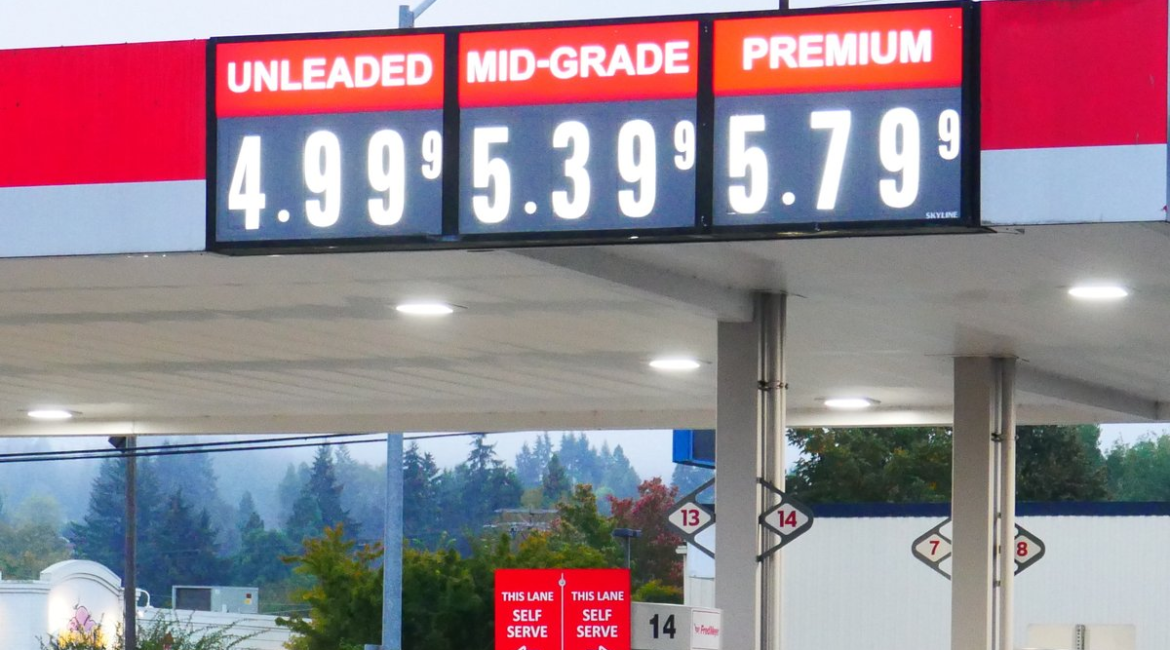
Americans heading into Thanksgiving week are getting two very different messages about the economy. At the gas station, the news keeps getting better. On their 401(k) statements, it got much worse last week. Both stories matter, and the next one, an inflation report due Wednesday, could decide which one the Federal Reserve listens to.
A note on timing: this article was written Sunday morning, Nov. 22. Stock and oil figures are Friday, Nov. 20, closing numbers. Gas prices are AAA’s national averages for Saturday and Sunday. U.S. markets reopen Monday.
A month of falling pump prices
AAA’s national average for a gallon of regular gasoline was $3.645 on Sunday, down from $3.659 on Saturday, $3.824 a week ago and $4.270 a month ago. That is a drop of about 62 cents in a month. According to MyNewsLA, which tracks AAA and Oil Price Information Service data daily, Saturday’s reading marked the 28th straight daily decline and the lowest national average since March 14. Sunday’s figure extended the slide.
The relief is real, but it needs context. Prices are still far higher than a year ago, when AAA’s average was $3.079. As of Saturday, MyNewsLA calculated that the national average was still about 68 cents above where it stood when the U.S.-Israeli war with Iran began on Feb. 28. AAA says August, September and October each set monthly records at the pump.
Diesel tells an even tougher story. AAA’s diesel average was $5.845 on Sunday, down from $6.309 a month ago but more than $2 above last year’s $3.796. Diesel moves the trucks, trains and farm equipment that carry nearly everything Americans buy, so high diesel prices keep pushing up the cost of groceries and goods well after gasoline eases.
Can drivers avoid a record Thanksgiving? The highest national average ever recorded on Thanksgiving Day was $3.58, in 2022. In its Nov. 19 fuel report, AAA said, “It’s possible the national average will drop another 15 cents by next Thursday and avoid setting a new record.” Prices have fallen about 8 cents since that report, so the average needs to drop about 6.5 more cents by Thursday. That is not guaranteed, but the trend is in drivers’ favor.
It matters for a lot of families. AAA projects 81.5 million Americans will travel at least 50 miles between Tuesday, Nov. 24, and Monday, Nov. 30, slightly fewer than last year’s 81.6 million. It is the first decline after three straight record years. AAA expects 72.9 million to drive, down 200,000, “due in part to this season’s record high gas prices.” Flying costs more too. AAA says round-trip domestic tickets booked for the holiday average about $800, up 17% from last year.
Why gas is falling: oil is giving back its war premium
Pump prices follow crude oil, and crude has dropped sharply. Brent, the international benchmark, settled Friday at $92.57 a barrel and U.S. West Texas Intermediate at $83.98, Reuters reported. Both rose on Friday but ended with a third straight weekly loss. According to Dow Jones Market Data, Brent has fallen $25.07, or 21.3%, over those three weeks, its largest three-week dollar decline since October 2008.
Reuters said the main reason is supply. Crude shipments through the Strait of Hormuz “have returned to roughly pre-war levels,” and traders increasingly expect a surplus. Dow Jones Newswires also pointed to President Trump’s decision to hold off on renewed large-scale strikes against Iran, a stronger dollar and broad weakness in commodities. The danger has not passed. Reuters noted that Friday’s late rally came partly from worries that attacks in the region could resume.
Conservatives have long argued that energy security is economic security, and 2026 has proved it. When a single chokepoint in the Persian Gulf was disrupted, American families paid record prices for months. As oil flows recovered, prices fell quickly. That is a strong argument for policies that make North American supply, refining capacity and pipelines easier to build. That way, the next Middle East crisis would cost American families less.
Meanwhile, on Wall Street: the worst week in years
Cheaper gas did nothing for stocks last week. As this magazine reported Saturday, the S&P 500 closed Friday at 6,910.39, more than 10% below its record and in correction territory. CNBC reported the index lost 8.6% for the week, the Dow fell 8%, its worst week since March 2020, and the Nasdaq fell about 10%. The selling was driven by fears about artificial intelligence spending and chip stocks.
The damage was even worse overseas. Taiwan’s benchmark TAIEX index, heavy with the chipmakers that supply the AI boom, lost 7,641.83 points, or 17.5%, for the week, its largest weekly point loss on record, Taiwan News reported. On Saturday, Taiwan’s Financial Supervisory Commission announced emergency measures starting Monday. They include a ban on short sales below the previous day’s closing price for all listed stocks, and an increase in the margin required for short sales from 130% to 150%. Regulators restrict short selling when they fear panic. Whether it works will be one of the first things investors watch when Asian markets open Sunday night, U.S. time.
The week ahead: a crowded Wednesday
Thanksgiving week is short. U.S. stock markets are closed Thursday and close early Friday. That pushes most of the important economic data into Wednesday, Nov. 25. According to CME Group and Newsquawk’s calendar, Wednesday brings the October personal consumption expenditures (PCE) price index, the Fed’s preferred inflation measure, along with the second estimate of third-quarter GDP, weekly jobless claims, durable goods orders and personal spending.
The PCE report is the one to watch. CMC Markets says forecasters expect headline PCE inflation to rise to 3.8% from a year earlier, up from 3.6% in September, and core PCE, which excludes food and energy, to rise to 3.2% from 3.1%. Those are forecasts, not results. It is the last major inflation report before the Fed’s Dec. 8–9 meeting, since the November consumer price index is not due until Dec. 10.
That timing explains why falling gas prices may not save stock investors. The October PCE data covers a month when gasoline was still near record highs, so it will not reflect November’s relief. And the Fed is focused on core inflation, which strips out energy. CME Group says a quarter-point rate increase in December is fully priced into futures markets, with about a 10% chance of a half-point move. Fed officials have argued that inflation has been above their 2% target for too long to ignore.
President Trump disagrees. At a White House briefing Friday, he pointed to India’s roughly 7% growth and lower interest rates and argued the U.S. could grow far faster if the Fed cut rates, according to The Hindu. The Fed is independent, though, and its officials have signaled they intend to keep tightening until core inflation clearly turns down.
The bottom line
Lower gas prices are the best economic news most Americans have had in months, and they arrive just in time for the busiest travel week of the year. But they do not erase a year of high prices, they have not yet reached diesel-dependent supply chains, and they will not show up in Wednesday’s inflation numbers. Investors hoping cheaper fuel will persuade the Fed to hold off on raising rates are likely to be disappointed. Add thin holiday trading and a key foreign market under emergency rules, and it could be another bumpy week. Enjoy the cheaper fill-up. Just don’t expect it to fix your portfolio by Friday.
Sources: AAA national fuel prices (Nov. 22, 2026), AAA fuel report (Nov. 19) and Thanksgiving travel forecast (Nov. 16); MyNewsLA (Nov. 21); Reuters via Investing.com and Dow Jones Market Data via Morningstar (Nov. 20); Dow Jones Newswires via Yahoo Finance; Taiwan News (Nov. 21) and Taiwan Financial Supervisory Commission (Nov. 21); CME Group, Newsquawk and CMC Markets week-ahead previews; The Hindu. Forecasts are labeled as such and may differ from actual results. This article is not investment advice.