
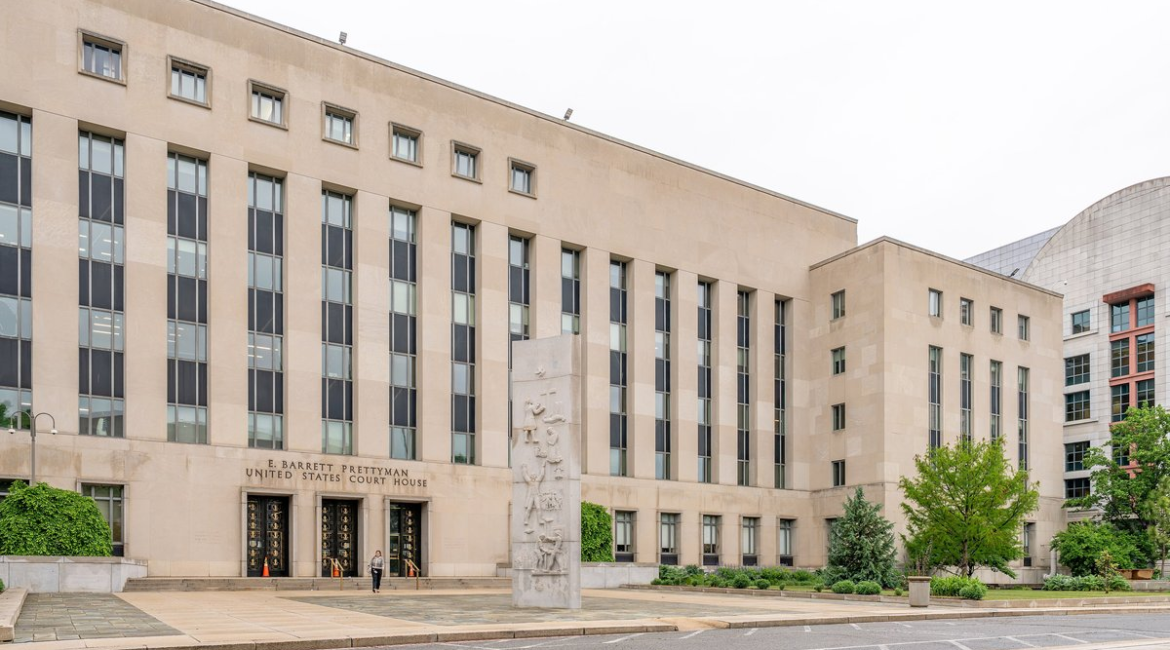
Federal judges usually write in careful, dry language. Magistrate Judge Zia M. Faruqui did not. “For years, the Administration has treated the weaponization of law enforcement like a horror movie villain coming for them,” he wrote on Tuesday. “Now the threat is finally real. Only the call is coming from inside the house—the White House.”
The line closes a 48-page memorandum opinion filed Nov. 24 in U.S. District Court in Washington. It explains why Faruqui threw out the false-statements case against two former FBI officials, Nicole “Nikki” Floris and Bradley Benavides. He announced that ruling from the bench on Nov. 2, the day before the midterm elections. The new opinion lays out the reasoning, and it amounts to a detailed account of how a politically charged prosecution was put together and then fell apart.
This is a government-accountability story, but not the usual kind. No one here is accused of taking a bribe. The question is whether the Justice Department met the most basic standard it must meet before charging anyone with a felony. The judge says it did not.
The charge
Floris was deputy assistant director and “functional head” of the FBI’s Foreign Influence Task Force from mid-2019 to mid-2022. Benavides was its section chief through the 2020 election. On Aug. 6, 2020, they gave a “defensive briefing” to Sens. Chuck Grassley, R-Iowa, and Ron Johnson, R-Wis., who were investigating the Biden family’s foreign business dealings. The senators have long said the briefing was an effort to discredit their work.
In 2023 both officials voluntarily sat for interviews with the House Judiciary Committee. They were not under oath, though they acknowledged that false testimony could be prosecuted. In October 2026, prosecutors charged each with one count of making false statements to Congress under 18 U.S.C. § 1001. The government alleged that they misrepresented what they knew about the FBI’s handling of Hunter Biden’s laptop.
When the charges were announced on Oct. 23, Grassley welcomed them. “These two unelected bureaucrats used the power of government to smear my and Senator Johnson’s constitutional oversight,” he said. “Today, we’re seeing accountability efforts in action.”
What the judge found
Prosecutors chose to charge by criminal complaint instead of seeking a grand jury indictment. That meant they had to show probable cause at a preliminary hearing, a low bar. According to Faruqui, they failed. His central findings, drawn from hearing testimony and cited in the opinion:
- A case ordered from the top. On July 16, 2026, the opinion says, President Trump used a national address to direct the FBI to investigate and charge FBI staff over perceived slights tied to the 2020 election. The next day, FBI Director Kash Patel ordered the Kansas City field office to investigate Floris and others. The lead case agent testified that the assignment process was unlike anything he had seen and that he worried the case would be seen as “political.”
- Key witnesses never interviewed. The agent said he was not allowed to interview Floris or Benavides, interviews he conceded would have been “absolutely valuable.” Investigators also did not question the House staffers directly. Instead they sent eight written questions to Mr. Castor, whom the opinion describes as the politically appointed general counsel for the committee’s Republican majority. The judge found that the questions mischaracterized the testimony.
- A materiality gap. To prove a false statement was “material,” prosecutors relied on Castor’s letter. But Castor was not present for Benavides’s 2023 interview, and the judge found no evidence that anyone at the committee read that transcript before answering. In a recorded call, a member of the U.S. attorney’s office told Castor, “I understand that it is our [expletive]-up.”
- An unauthorized filing. At 12:43 a.m. on Oct. 27, hours before the hearing, prosecutors filed a “superseding complaint” that the court had not authorized. The judge said a career prosecutor conceded that the government had “never before charged someone this way.”
- Ambiguous questions. Much of the alleged lying, the opinion says, came from loose exchanges. In one, Benavides said his current knowledge that the FBI had the laptop came from a Wikipedia article he read before the interview. The judge found that these answers did not show anyone knowingly lying.
“Because the government was unwilling or unable to obtain a grand jury indictment, the rules required the government to establish probable cause in a preliminary hearing,” Faruqui wrote. “The government failed this simple task.”
‘Not a one-off mistake’
The judge went beyond this case. “This court has seen a line of botched, politicized cases where the government has rushed to charge cases, only to have them fall apart,” he wrote. He cited an earlier D.C. ruling finding that during an eight-week federal surge, prosecutors moved to dismiss 21% of cases charged by complaint, compared with about 0.5% over the prior decade. He also wrote that grand juries “refused to indict more cases in the last year than in the prior 10 years combined.”
He described the damage to the defendants, who are “decorated” former officials by his account. “The stain this prosecution leaves on the good names of Ms. Floris and Mr. Benavides is incalculable,” he wrote, noting that the Justice Department and Grassley still had press releases online celebrating the dismissed complaint. He warned about the effect on the bureau: “The takeaway for FBI staff is to be afraid. They are one tweet away from being prosecuted by their own government.”
He also flagged a consequence that should worry Republicans in particular. If honest mistakes in voluntary testimony can be charged as felonies, more witnesses will simply plead the Fifth. “Congress will lose its ability to investigate as more and more witnesses refuse to answer their questions,” he wrote.
The government’s side
When the case was dismissed in early November, the Justice Department said it “disagrees with the Magistrate’s decision, which remarkably appears to suggest that high-ranking government officials are immune from accountability for making materially false statements to Congress,” NBC News reported. “We are evaluating all options,” the department said, adding that its actions “will continue to be guided by the facts, the evidence, and the law — not politics.” A department spokesperson did not immediately respond to ABC News about Tuesday’s written opinion.
The dismissal does not bar prosecutors from going to a grand jury. The judge wrote that the government “could have—and should have” done so from the start. Floris and Benavides have not been convicted of anything, and for now no charge is pending against them.
Why this matters beyond one case
Conservatives spent years arguing, often with good reason, that federal law enforcement was turned against the right. The Biden family investigations, the FBI’s handling of the laptop and the treatment of Republican senators who asked questions were all fair subjects for oversight. Lying to Congress is a real crime, and officials who do it should be held to account.
But accountability requires evidence, and the order in which things are done matters. Investigate first, interview the witnesses, then charge. If a grand jury of ordinary citizens won’t find probable cause, that is information, not an obstacle to work around. The safeguards that protect two former FBI officials today are the same ones that will protect a conservative activist, a Republican staffer or a future Trump appointee when the other party holds power. In January, Democrats take over both chambers of Congress and their committee subpoenas. Everyone in Washington has a stake in keeping those safeguards strong.
Faruqui put it plainly: the government “is not free to use this weapon unchecked. The rule of law is still a shield against it. And that shield is in the hands of grand juries and courts.”
Sources: Memorandum Opinion, United States v. Floris and Benavides, No. 26-mj-00185 (D.D.C., filed Nov. 24, 2026); NBC News; ABC News; The Independent; Senate Judiciary Committee press release (Oct. 23, 2026). Statements about the investigation’s origins and conduct are the court’s findings based on hearing testimony. Floris and Benavides were not convicted of any crime, and the Justice Department disputes the ruling.



