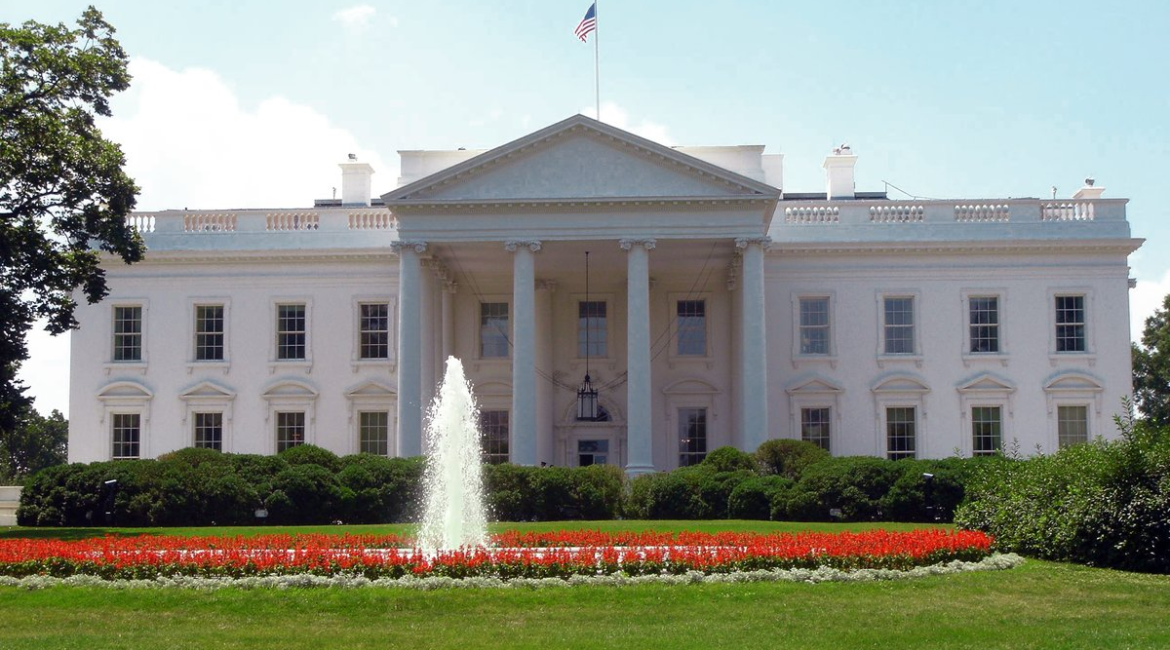
Six days after an election that Republicans lost in both chambers, President Trump walked into the White House briefing room unannounced on Monday and offered his clearest signal yet that the shooting phase of the Iran war may be over. “Iran, militarily, is effectively over. We’re just keeping it the status quo, and we’re doing that really at the behest of countries that are their neighbors,” he told reporters, according to The Washington Post.
The same afternoon, Rep. Thomas Massie formally introduced eight articles of impeachment against Defense Secretary Pete Hegseth, forcing the House to act on them within two legislative days. Together, the two events made Monday the day Washington’s post-election argument over the war moved from talk to votes. It is the most-discussed political story of the last 24 hours, and it puts every House Republican on the spot this week.
What the president actually said
Trump’s remarks followed an Oval Office meeting with Qatari Prime Minister Sheikh Mohammed bin Abdulrahman Al Thani, who has served as a go-between with Tehran. The BBC reported that Trump called renewed U.S. attacks “highly unlikely,” cited “positive momentum” in negotiations, and added that the United States remained “locked and loaded” if circumstances changed. The Guardian quoted him saying, “We’re seeing momentum toward the end of this conflict. I think it’s going to be ending fairly soon.”
The “status quo” is not a peace. According to Al Jazeera’s account, Trump said Qatar, Saudi Arabia, the UAE, Bahrain and Kuwait “would prefer the status quo,” which he described as “a continuation of the greatest naval blockade in the history of our country.” Asked why he would not simply declare the war over, he said Gulf allies could still be hurt and called for a “long-term solution.” Al Jazeera also said the Qatari leader reportedly brought an Iranian proposal to end the war; that report is unconfirmed.
The blockade is getting wider, not narrower. On Saturday, U.S. Central Command announced Task Force Iron Gate, a team of about 20 civilian and military personnel in Tampa that will coordinate with other agencies to stop “advanced weapons systems, dual-use technologies, sanctioned materials, and illegal revenue streams” from crossing Iran’s land borders and the Caspian Sea. CENTCOM said the naval blockade has kept Iran from exporting more than $25 billion in crude oil in recent months. CNBC, citing a Reuters investigation, said Iran had built a network that imported at least $2 billion in hardware, explosives and heavy trucks since January 2025, by ship across the Caspian from Russia, by truck from Central Asia and by air from China.
Tehran was not impressed. Al Jazeera quoted Mohsen Rezaei, secretary of Iran’s Supreme National Security Council, accusing Washington of “manufacturing FAKE NEWS about imaginary talks.”
Why the timing matters
The Guardian noted that Trump has frequently said a deal was imminent during the nearly nine-month war, so his words deserve some caution. But the political setting is new. The BBC pointed out that Vice President JD Vance and other senior Republicans blamed last week’s defeats on the war, and that in a 60 Minutes interview aired Sunday, Trump said he did not currently see “any reason” to escalate. Markets took the remarks at face value: Reuters reported Tuesday that Brent crude slipped below $90 a barrel for the first time since late August.
For conservatives who backed the war’s aims, the question is whether a blockade can lock in those gains without new American casualties. For skeptics, it is whether “effectively over” means Congress should finally weigh in. Both questions reach the House this week.
The impeachment clock
CBS News reported that Massie, a Kentucky Republican who lost his primary this year, introduced a 34-page resolution with eight articles accusing Hegseth of high crimes and misdemeanors. Three articles say he abused the powers of the Defense Department by waging war on Iran without congressional authorization. Others concern a strike on an Iranian school, the Caribbean boat strikes, the capture of Venezuela’s Nicolás Maduro and the Pentagon’s treatment of Sen. Mark Kelly. PolitiFact said a further article concerns U.S. military actions in Yemen, and that the House is expected to vote by Nov. 11 unless Republicans kill the measure with a motion to table or refer it.
These are accusations in a resolution, not findings. Hegseth has called them “sham articles of impeachment” from “a disgruntled, defeated congressman,” CBS reported, and told reporters Monday, “we’re not worried about that.” He said he would hold a news conference on the effort Tuesday morning. Trump defended him on Sunday: “I believe we saved the Middle East and Israel combined. And it’s awfully hard to say, ‘Let’s impeach somebody who did that,'” according to PolitiFact. Speaker Mike Johnson said impeaching a defense secretary during hostilities “would be a terrible, terrible look.”
Counting the votes
PolitiFact said three Republicans would need to join every Democrat for a simple majority. Attendance could matter as much as conviction. MS NOW reported that only 399 members voted Monday night, 202 of them Democrats, meaning Democrats could hold an effective majority on the floor during the lame-duck week if Republicans do not show up.
Republicans are split in revealing ways. Retiring Rep. Don Bacon of Nebraska said he is “wrestling” with the vote: “I don’t think he’s been a good secretary, but do you impeach a guy for that? It has to be a high crime or misdemeanor,” CBS reported. Rep. French Hill of Arkansas said he wants to hear the debate “to see if it merits impeachment versus some other disciplinary action.” Oversight Chairman James Comer said “there’s a lot of questions about Hegseth.”
Others drew a firm line. Rep. Mike Lawler, who lost his race, told MS NOW he would vote no, arguing that, unlike the 2024 case against Homeland Security Secretary Alejandro Mayorkas, “there have been no hearings, no investigations, no opportunity for the Secretary to answer the charges.” Rep. Warren Davidson of Ohio, who has backed war powers resolutions, said impeaching Hegseth “for a decision he didn’t make is blame-shifting from Congress and the president.” Democratic leader Hakeem Jeffries, expected to become speaker in January, has called himself a “hard yes.”
Even if the House impeaches, removal requires two-thirds of the Senate. Massie argued that if the current Senate does not act, the matter would pass to a Democratic Senate next year, CBS reported. Only two Cabinet secretaries have been impeached: William Belknap in 1876 and Mayorkas in 2024. Belknap was acquitted, and the charges against Mayorkas were dismissed.
The bottom line
Lawler and Davidson raise a point conservatives should take seriously: impeachment is not a substitute for Congress doing its own job. If lawmakers believe the war needed authorization, the constitutional remedy is to debate and vote on authorization; MS NOW notes House Republicans repeatedly rejected Democratic measures to curtail the war this year. At the same time, Bacon’s standard, that a bad performance is not a high crime, is the right test for each member to apply to the actual articles. With the president now saying the military fight is “effectively over,” the House has a chance to settle what comes next on the merits, through hearings, an authorization debate or a recorded vote, rather than leaving the war’s legal footing to be argued in a lame-duck procedural fight.
Sources: The Washington Post, BBC, The Guardian and Al Jazeera on the president’s Nov. 9 remarks; CENTCOM’s Nov. 7 release and CNBC on Task Force Iron Gate; Reuters via Business Standard on oil prices; CBS News, PolitiFact and MS NOW on the impeachment resolution and vote count. The impeachment articles are allegations; no finding has been made. The reported Iranian proposal is unconfirmed.