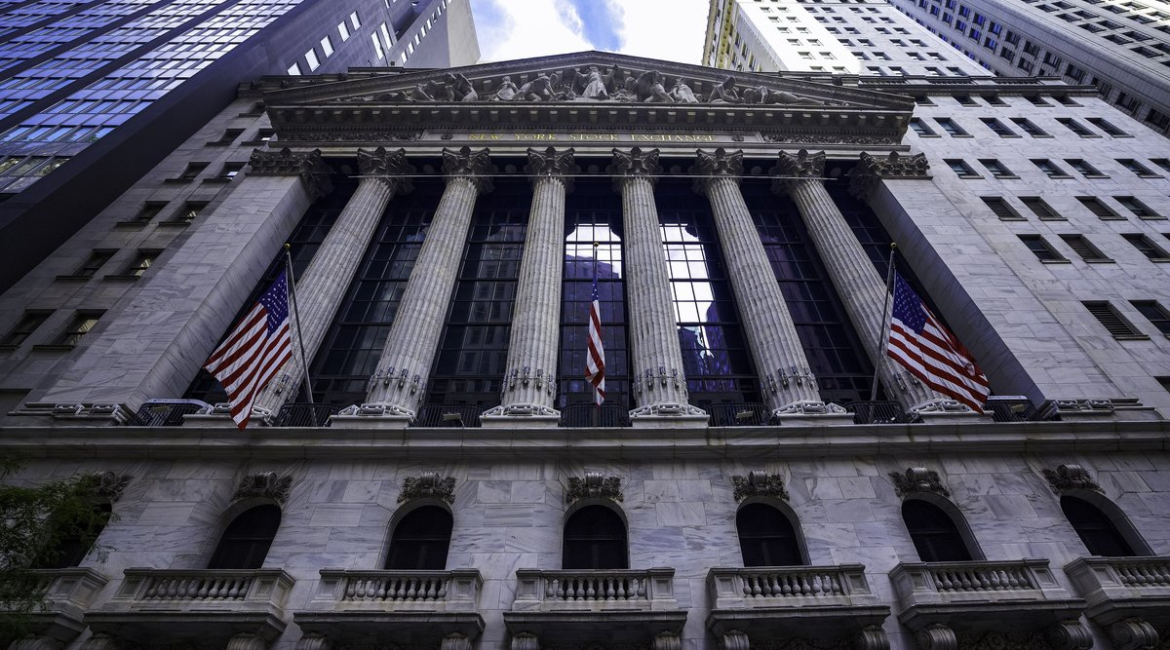
Wall Street shows up for Black Friday after all. After two straight days of selling heading into Thanksgiving, stock futures rose sharply early Friday as investors returned to the battered artificial-intelligence trade. Markets open for a shortened session today. The New York Stock Exchange and Nasdaq close at 1 p.m. Eastern (noon Central), and the bond market closes at 2 p.m. Eastern.
All of the figures below are premarket readings from early Friday morning. They are not closing prices, and in a half-day session with light volume they can change quickly.
The early numbers
As of 4:23 a.m. Eastern, Reuters reported that Dow E-mini futures were up 669 points, or 1.33%. S&P 500 futures were up 1.98% and Nasdaq 100 futures were up 2.87%. Around 5 a.m. Eastern, Barron’s had nearly identical figures: S&P 500 futures up 2%, Nasdaq 100 futures up 2.8% and Dow futures up about 650 points.
Chip stocks led the move. Reuters said Nvidia was up 4.7% in premarket trading but still more than 37% below its October record high. AMD was up 7% and Broadcom 4.7%. Alphabet, Amazon, Microsoft, Meta and Oracle gained between 2.3% and 5.3%. The cue came from Asia. Barron’s noted that South Korea’s KOSPI, which tends to track AI because its two biggest components are memory-chip makers SK Hynix and Samsung, closed 4.3% higher on Friday.
Kathleen Brooks, research director at the brokerage XTB, urged caution. “The recovery in stocks seems technical,” she told Reuters. “The questions that caused the market panic are still unanswered.”
Where Wednesday left things
The starting point matters. On Wednesday, the last full session before the holiday, CNBC reported that the Dow rose 164.25 points, or 0.33%, to 50,182.95. The S&P 500 fell 0.25% to 7,182.78, and the Nasdaq Composite fell 0.62% to 23,585.80.
Even with the rebound, November has been bad. Reuters said the S&P 500 and Nasdaq are on course for their worst November since 2008. All three major indexes went into correction territory this month, and at one point the Nasdaq was down nearly 20% from its October peak. Reuters also reported that the S&P 500 and Nasdaq are headed for their best week since August, while the Dow is on pace for its best week since April 2025. Both of those depend on how Friday’s short session ends.
The Fed is still the main issue
Nothing that happened over the holiday changes the Federal Reserve outlook. This week’s data showed third-quarter growth revised up to a 4.3% annual rate and inflation that is still running hot. As of Thursday, CNBC reported that traders saw a nearly 100% chance of a rate hike at the Fed’s December meeting, based on the CME FedWatch tool, and were also pricing in another hike in January. Those are market-implied probabilities, not Fed decisions.
Yields were moving the other way early Friday. Yahoo Finance reported the 10-year Treasury yield had fallen to 4.84%. Oil rose: Brent crude climbed to about $92 a barrel after Houthi militants stepped up attacks on energy infrastructure in Saudi Arabia, according to the same report. With the Iran war ongoing, higher oil prices feed into the inflation readings the Fed is reacting to.
Trade is also a factor. On Wednesday, the Associated Press reported that the administration proposed new Section 301 tariffs on China, the European Union, Japan, South Korea, Taiwan and others. U.S. Trade Representative Jamieson Greer told CNBC he did not expect any of them to take effect “earlier than a couple months from now.” The rates are still proposals.
Main Street’s Black Friday
The other Black Friday story is at the checkout counter, and the data there are partly real and partly forecast.
The real part: Adobe Analytics reported that U.S. consumers spent $82.5 billion online from Nov. 1 through Nov. 22, up 9.1% from $79.5 billion a year earlier. Every day in that period topped $3 billion. “Buy now, pay later” plans accounted for $6.1 billion of that spending, up 6.5%.
The forecast part: Adobe projected $6.9 billion in online spending on Thanksgiving Day, $12.9 billion on Black Friday and $15.1 billion on Cyber Monday. It also forecast $47.5 billion for the five-day Cyber Week and $275.1 billion for the full season, up 6.7%. The National Retail Federation, in an Oct. 15 forecast, projected that November-December retail sales would grow 4.2% to $1.013 trillion, excluding autos, gas stations and restaurants. These are all projections. Actual Thanksgiving and Black Friday totals had not been published when this was written.
Two cautions apply. First, these figures are in current dollars. With October’s PCE price index up 3.8% from a year earlier, according to the Commerce Department, a 4% to 7% increase in sales leaves much less growth after inflation. Second, NRF chief economist Mark Mathews said that “inflation, rising gas prices and pressure on household spending will affect consumers differently across income groups.” Adobe’s own forecast expected many shoppers to use the discounts to stock up on household basics such as hygiene and cleaning products, not just gifts.
What to watch today
- Whether the bounce holds through the close. Holiday-shortened sessions are thin. A rally that holds into 1 p.m. Eastern means more than one that fades.
- Chips versus everything else. If the rally stays narrow and limited to semiconductors and AI-related names, Friday’s gains may not hold.
- Oil and yields. Brent near $92 and a 10-year yield in the mid-4.8% range are the two inputs most likely to change what the Fed does in December.
- Weekend shopping data. Adobe and other trackers usually report results over the holiday weekend. Those actual numbers will be more useful than any forecast.
The bottom line
From a conservative perspective, the main point is simple. One morning of futures buying doesn’t change the basic picture: strong growth, inflation still too high, and a central bank expected to raise rates again. Families feel that through prices, not through the Nasdaq. A record holiday season in dollar terms can still mean a squeezed household once inflation is taken out. In Washington, the practical response is to stop adding to the problem through deficit spending, new tariff uncertainty and higher energy costs. The Fed can’t fix those on its own.
Sources: Reuters via Investing.com; Barron’s; Yahoo Finance; CNBC; Associated Press via PBS NewsHour; Adobe Analytics via Adobe and Chain Store Age; National Retail Federation; U.S. Bureau of Economic Analysis. Futures, premarket prices and yields are early-morning readings as of the times noted and will change during the session. Fed odds are market-implied probabilities. Adobe and NRF holiday figures, other than Adobe’s Nov. 1–22 total, are forecasts.