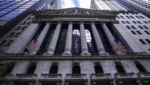
The best week for American stocks in more than a year ended at 1 p.m. Eastern on Black Friday. Wall Street closed early for the holiday, retailers stayed open, and both sets of numbers pointed the same way: investors and shoppers are still spending. What neither can do is cancel the interest-rate hike the Federal Reserve is now all but certain to deliver in 11 days.
On Friday the Dow Jones Industrial Average rose 591.99 points, or 1.18%, to 50,774.94. The S&P 500 gained 114.71 points, or 1.60%, to 7,297.49, and the Nasdaq Composite added 543.70 points, or 2.31%, to 24,129.50, Reuters reported. For the holiday-shortened week, the S&P 500 rose 5.6%, the Nasdaq 6.68% and the Dow 5.46%. That was the S&P 500’s biggest weekly gain since April 2025, and CNBC noted it was the Dow’s best week since October 2022.
How the week happened
The rebound began Monday, when Nvidia reinstated Jensen Huang as chief executive. CNBC reported that the stock jumped 31% that day and the S&P 500 and Nasdaq had their best sessions since April 2025. AI stocks then gave back part of the gain on Tuesday and Wednesday before buyers returned on Friday.
On Friday the buying was led by the chip stocks hit hardest this month. Reuters reported that Micron rose 7.6%, Marvell 7.3% and the broader semiconductor index 4.7%. Data-storage company Sandisk jumped almost 16%. Nvidia itself trailed for most of the session and closed up 0.8%. Amazon rose about 4% on the first day of the holiday shopping season, and Anthropic, which went public a week earlier, rose about 11% to close back above its $83 IPO price, according to StockAnalysis. The gains were broad: Reuters counted advancing NYSE stocks ahead of decliners by about 3.25 to 1, and Xinhua reported that all 11 primary S&P 500 sectors finished higher.
“The market is so oversold that a bounce was inevitable,” Jamie Cox of Harris Financial Group told Reuters. Andrew Slimmon of Morgan Stanley Investment Management said so much “fast money” had pulled out of tech that the move “could have persistence next week as they are forced to chase back in.” That is a forecast, and the week’s swings are a reminder of how quickly sentiment can change.
Still a bad month
One good week does not make up for a bad November. Reuters reported that the S&P 500 and Nasdaq are on track for their worst November since 2008, with one trading day left on Monday. StockAnalysis calculated that the S&P 500 finished Friday 6.7% below its Oct. 6 record close. A week earlier, on Nov. 20, the index had closed in correction territory, and the Nasdaq-100 ended 19.8% below its record, just short of a bear market.
Fear has eased but has not gone away. CNBC reported that the VIX volatility index had fallen about 30% for the week, after jumping 86% the week before to close at 35.89 on Nov. 20.
The Fed has made up its mind
The rally did not change what traders expect from the Fed. As of early Friday, CME FedWatch showed a 99.2% probability of a quarter-point rate increase at the Fed’s Dec. 9 decision, according to an Investing.com analysis. That would lift the federal funds target range to 4.00% to 4.25%. The same analysis reported that core PCE prices, the Fed’s preferred inflation gauge, rose 3.3% in the year to October. That was above the 3.2% forecast and the fastest pace since November 2023.
Last week’s GDP revision also mattered. Reuters noted that traders are almost fully pricing in a hike after data showed the economy grew much faster than first estimated in the third quarter, at a 4.3% annual rate instead of 3.4%, while inflation picked up in October.
The open question is what happens after December. At Wednesday’s close, futures put a 60.1% probability on a second hike by the Jan. 27 meeting. That was down from 67.4% a day earlier, even though inflation came in above forecast. The two-year Treasury yield, which follows expected Fed policy, closed at 4.63% on Nov. 24. That is still well above where the top of the target range would be after one hike, a sign that bond traders expect more than one. These are market-implied odds, not Fed decisions, and they change quickly. On Nov. 20 alone, the probability of a January hike swung by about 20 points.
The Fed’s quiet period begins today, Saturday, Nov. 28, so officials will not comment on policy again until after the decision. The data releases matter most from here: the November jobs report on Friday, Dec. 4, and November consumer prices on Dec. 10, the morning after the Fed announces its move.
Shoppers kept spending
Consumers did not wait for lower rates. Adobe Analytics reported that U.S. shoppers spent $9.7 billion online on Black Friday through 6:30 p.m. Eastern, up 12.8% from a year earlier, Reuters reported. Adobe projected a final total of $13 billion to $13.4 billion, above the $12.9 billion it had forecast in September. Thanksgiving Day online sales came in at $7.1 billion, up 10.4% and ahead of Adobe’s $6.9 billion forecast, Digital Commerce 360 reported.
Not every tracker shows the same pace. Salesforce, which measures a different set of retailers, projected $18.7 billion in U.S. Black Friday online sales, up only 4%, according to the same Reuters report. Adobe’s forecasts for the rest of the weekend are $6.1 billion on Saturday, up 6%, and $6.4 billion on Sunday, up 7.5%. It expects $15.1 billion on Cyber Monday, up 6.2%, and $47.5 billion for the five days from Thanksgiving through Cyber Monday, up 7.4%. All of those are forecasts. The Black Friday total is preliminary until Adobe publishes its final count.
Most of these figures are in nominal dollars. With core inflation running above 3%, some of that growth reflects higher prices rather than more goods sold. Online sales also capture only part of holiday retail. The Commerce Department’s broader retail sales data for November will give a fuller picture next month.
Other markets
CNBC reported that Brent crude traded in the mid-$90s a barrel on Friday and was headed for a weekly gain, as Yemen’s Houthis kept targeting Saudi energy infrastructure. U.S. crude was in the low-to-mid $80s. Different snapshots during the day showed different prices, so treat those as approximate. Gold and silver rebounded after a hard month. CNBC reported gold futures above $3,600 an ounce at one point Friday, still down almost 7% for November, and silver up sharply but more than 12% lower for the month.
What it means
The week’s results point in two directions. Investors bought the dip in American technology firms, and households, at least online, opened their wallets during the year’s biggest shopping weekend. Both are signs of underlying strength.
But an economy that is growing quickly while core inflation rises above 3% is the kind the Fed tries to slow, and Wall Street now expects at least one hike and possibly more. Rate hikes raise the cost of mortgages, car loans and credit card balances, including the holiday spending going on now. Easing inflation, not a rally driven by sentiment, is what would lift that pressure. In the meantime, Washington could help by cutting the borrowing and spending that work against the Fed. Monday’s month-end close and Friday’s jobs report are the next tests.
Sources: Reuters via Investing.com; CNBC; StockAnalysis; Xinhua; Investing.com analysis citing CME FedWatch; Adobe Analytics via Reuters and Adobe; Salesforce via Reuters; Digital Commerce 360. Fed probabilities are market-implied odds, not Fed decisions. Adobe’s Black Friday total is a preliminary projection, and its weekend, Cyber Monday and Cyber Week figures are forecasts. Analyst comments about next week are forecasts. Oil and precious-metal prices are intraday readings that varied during Friday’s session.