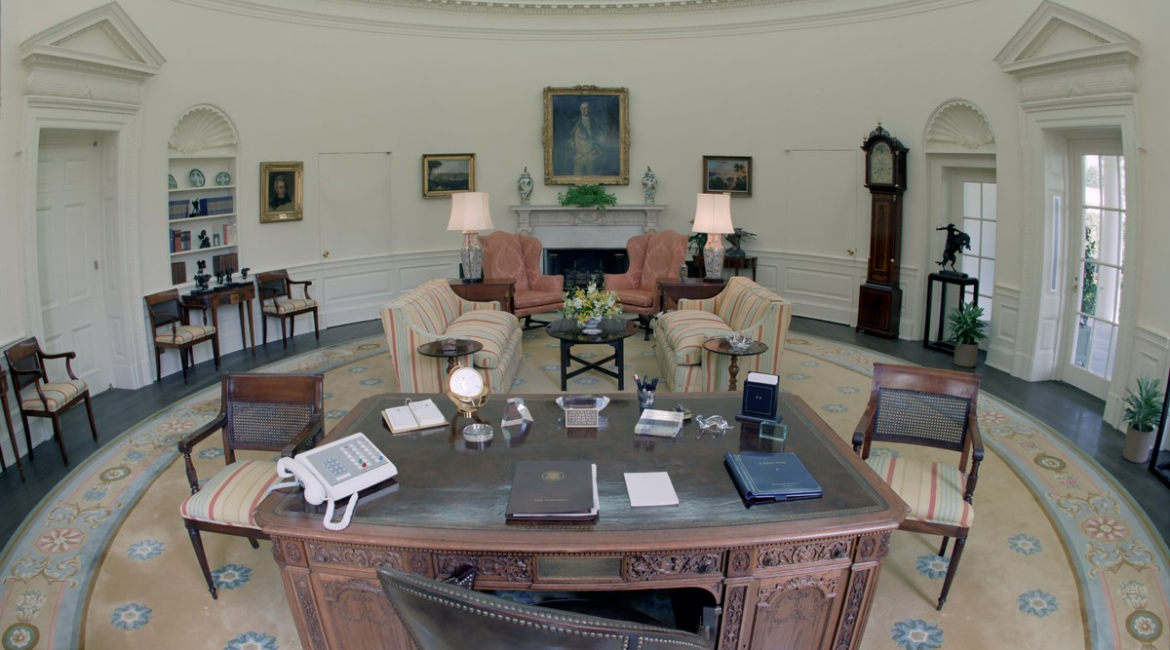
One day after Republicans lost both chambers of Congress, President Donald Trump’s first official post-midterm act was not a veto threat aimed at Iran funding, or a Cabinet shake-up. It was a proclamation declaring the Oval Office — along with the Outer Oval Office and the Cabinet Room — a national monument.
He signed it in the room itself on Thursday, Nov. 5, with a red “VETO” baseball cap on the Resolute Desk, while defending the Iran war and Defense Secretary Pete Hegseth against a growing impeachment push. The symbolism was thick. The legal effect is thinner than the rhetoric. Here is what the proclamation actually does, what it does not do, and how it fits the political fight now underway.
What the proclamation says
The White House proclamation, issued under the Antiquities Act (54 U.S.C. § 320301), establishes the “Oval Office National Monument.” Its boundaries are the Oval Office (Room 110), the Outer Oval Office (Rooms 106 and 108), and the Cabinet Room (Room 105).
The Secretary of the Interior, through the National Park Service, is directed to manage the monument, develop a management plan with the White House Office of Administration, and require “documentation, review, and consideration of alternatives before any action that would substantially alter or demolish the monument or its essential architectural elements.” The proclamation also calls for coordination with the Committee for the Preservation of the White House.
Importantly, the text itself carves out day-to-day presidential control. “Nothing in this proclamation shall be construed to restrict the President’s authority to redecorate the monument, select furnishings, or make ordinary operational and security modifications that do not substantially impair the monument’s historic structure or architectural character.” It also states that nothing in it alters existing statutory exemptions for the White House under the National Historic Preservation Act, or diminishes Congress’s authority over federal property.
The White House fact sheet frames the move as ensuring the Oval Office “gets the historic recognition and protection it deserves.” The proclamation itself notes that the White House and its grounds are already a National Historic Landmark administered as part of the President’s Park by the National Park Service.
What Trump said — and what the law allows
In remarks covered by CBS News and the Associated Press, Trump described the order in sweeping terms: the Oval Office “will not be allowed to be touched by anybody, destroyed, ripped down by stupid people, in order to build something in a slightly different shape.” CBS reported he also said major changes would need congressional review. ABC News reported he indicated the proclamation would be sent to Congress to be “ratified.”
That congressional-ratification claim is not in the proclamation’s text. Antiquities Act proclamations are presidential acts. Future presidents can revise or revoke them — something Trump himself has done with monuments designated by predecessors. CBS noted the obvious: the order does not stop a future president from restyling the office, and it does not stop a successor from rolling the proclamation back.
Asked whether a future president could remove the gold accents Trump has added, he indicated a successor could, “very carefully,” ABC reported. In other words, furniture and décor remain fair game. Structural demolition is what the review process is aimed at. Whether that process would actually bind a future White House is a political and legal question that courts and Congress would decide if it ever comes up.
The political backdrop: Iran, Hegseth, and a Democratic Congress
The monument signing landed in the middle of a fight over the war and the Pentagon. Vice President JD Vance has said “the reason we lost is the war.” Trump has called that assessment largely true while insisting he would not have handled Iran differently. On Thursday he again defended Hegseth, saying the defense secretary “has done a fantastic job,” according to NBC News.
Rep. Thomas Massie, R-Ky., said he plans to reintroduce articles of impeachment against Hegseth when the House returns, unless Hegseth resigns. Massie urged Trump to replace him while Republicans still hold the Senate for confirmations. Hegseth answered with a video dismissing “sham articles of impeachment” from a “disgruntled, defeated congressman” and Democratic allies.
Fox News reported several House Republicans privately expect Massie’s privileged resolution could pass in the lame duck, especially if defeated GOP members skip the final weeks. House Minority Leader Hakeem Jeffries posted, “Why is Pete Hegseth still around?” Rep. Jason Crow, D-Colo., said before the election that ousting Hegseth would be his “priority No. 1” if Democrats retake the House, the Washington Examiner reported from Crow’s Oct. 25 Face the Nation appearance. Impeachment in the House is not removal: conviction still requires a two-thirds Senate vote, and no Cabinet secretary has ever been removed that way.
The “VETO” hat on the desk was message discipline. Democrats will control the next Congress. Trump is signaling he will use the veto pen. Preserving the Oval Office’s architectural shell, while daring opponents to come after his Cabinet, is of a piece with that posture.
Legal limits, plainly stated
- Future presidents can still redecorate. The proclamation says so.
- Proclamations can be reversed. Trump has reversed monuments before; a successor can reverse this one.
- The White House is already a National Historic Landmark. The proclamation adds a discrete monument designation for three rooms, not a brand-new historic status for the complex.
- Congress retains authority over federal property. The text acknowledges that.
- Impeachment talk is political, not proven misconduct. Allegations in the Iran-war fight belong in hearings with evidence, not in slogans.
The bottom line
Americans can debate whether the Oval Office needs a special Antiquities Act wrapper on top of its existing landmark status. What they should not confuse is theater with law. Thursday’s proclamation does not freeze the gold appliqués in amber, does not require a congressional vote to change the drapes, and does not settle the Hegseth fight.
Constitutional conservatives should want two things at once: respect for the historic rooms where presidents actually work, and honesty about the tools being used. If the goal is lasting preservation, Congress can legislate. If the goal is messaging after a midterm rout, say so. The Iran war, the chain of command, and the confirmation calendar are the substantive fights. A monument proclamation is not a substitute for them.
Proclamation text and White House fact sheet are primary sources. News accounts of Trump’s remarks and of Massie, Jeffries, Crow and Hegseth statements are attributed above. No finding of wrongdoing by any named official is implied.