Europe’s migration debate and its nuclear debate are usually held in separate rooms. They should not be. Years of poorly managed migration have reshaped European politics, and that politics will decide how the continent guards the most dangerous weapons on its soil. The real question is not whether some outside group could seize an arsenal; the safeguards below are built so that none can. It is whether governments that lose public trust on borders can still make the steady decisions deterrence demands, and whether hostile powers will exploit the strain.
Migration’s real political impact
Start with the numbers, because they cut against both complacency and panic. Frontex reports that irregular border crossings into the EU fell 26% in 2025 to almost 178,000, the lowest level since 2021. In the first nine months of 2026, detections fell by almost another third, to just over 91,000. Frontex credits cooperation with partner countries and preventive measures in departure states. Firm policy works.
But arrivals are only the front door. The EU Agency for Asylum counted about 822,000 asylum applications in EU+ countries in 2025, down 19% from 2024, with Germany (163,000), France (152,000), Spain (143,000) and Italy (134,000) receiving the most. At year’s end, an estimated 1.2 million cases were still pending across all instances, and the EU+ recognition rate had fallen to 29%. Most claims fail, yet the system stays clogged.
Enforcement is where public confidence breaks. Eurostat data show that 491,950 non-EU nationals were ordered to leave the EU in 2025, while 155,110 were returned after an order to leave. Because some returns follow orders from earlier years, the two numbers are not a perfect match, but the gap is unmistakable: roughly one return for every three orders. Integration also lags. In 2025, according to Eurostat, the employment rate for non-EU citizens aged 20 to 64 was 65.2%, against 77.0% for nationals, and their unemployment rate was 12.3%, more than double the 5.2% for nationals.
Brussels has responded. The Pact on Migration and Asylum, a package of 10 laws, entered into application on June 12, 2026. It requires screening and registration of all irregular arrivals, mandatory border procedures for those unlikely to qualify for protection or who pose security risks, and a mandatory but flexible solidarity mechanism. On October 7, the EU adopted a new Return Regulation that, according to the Council, imposes obligations on people with no right to stay, sets stricter rules for those who pose a security threat, and allows return hubs in non-EU countries that respect human rights and non-refoulement. These rules came late, and some member states have openly defied the old ones. In June 2024 the EU Court of Justice ordered Hungary to pay a €200 million lump sum and €1 million per day for failing to comply with EU asylum rules.
Voters have noticed. In Germany’s February 2025 federal election, the AfD won 20.8% of the vote and finished second. In Saxony-Anhalt’s state election on September 6, 2026, it took 43.8% of the list vote and 39 of 83 seats. In the Netherlands, the governing coalition collapsed in June 2025 after Geert Wilders pulled his party out in a dispute over asylum policy. Voters are punishing parties that promised control and did not deliver it.
How Europe’s nuclear weapons are actually controlled
France runs a fully independent force. Speaking at the Île Longue submarine base on March 2, 2026, President Emmanuel Macron said that “the final decision lies in the hands of the President of the Republic alone,” according to the official transcript. In that speech he announced an increase in France’s warheads and said France would no longer publish arsenal figures. The last official figure, from 2020, was under 300 weapons. France does not take part in NATO’s nuclear sharing mission.
The United Kingdom keeps a single system: Trident missiles aboard four Vanguard-class submarines, with at least one always on patrol. The government says its weapons are “operationally independent and only the Prime Minister can authorise their use,” and has capped the stockpile at no more than 260 warheads. In June 2025 Britain also announced it would buy F-35A jets and join NATO’s nuclear mission.
The United States deploys an estimated 100 B61-12 bombs at six bases in five countries: Aviano and Ghedi in Italy, Büchel in Germany, Incirlik in Türkiye, Kleine Brogel in Belgium and Volkel in the Netherlands, according to the Federation of American Scientists’ Nuclear Notebook. NATO’s own factsheet says these weapons “remain under US custody and control,” and that a nuclear mission requires explicit approval by NATO’s Nuclear Planning Group and authorization from the U.S. President and the UK Prime Minister. “It is not the sharing of nuclear weapons,” NATO states.
The hardware enforces that rule. The Pentagon’s Nuclear Matters Handbook describes the Permissive Action Link as a device that blocks arming “until the insertion of a prescribed, discrete code.” It also describes the two-person rule and the screening programs for everyone with access. The system is designed so that neither a change of government in a host country nor an intruder at the fence would yield a usable weapon.
The real risks
Strong locks do not end the conversation. The genuine vulnerabilities are political and human, and several have already shown themselves.
Host-nation instability. During Turkey’s failed coup in July 2016, Turkish authorities cut commercial power to Incirlik, which ran on backup generators, and the Turkish base commander was detained. The weapons stayed secure, but access to a nuclear site briefly depended on a host government’s internal crisis.
Espionage and drones. In late 2025, drones repeatedly flew over Kleine Brogel. Belgium’s defense minister, Theo Francken, called it a likely spying operation, and Belgium’s federal prosecutor opened investigations.
Insider lapses. In 2021, Bellingcat found that U.S. service members had posted security details about European nuclear bases on public flashcard apps. Carelessness, not treason, but exactly the gap an adversary looks for.
Terrorism and extremism. Europol’s 2026 terrorism report counted 45 terrorist attacks (completed, failed or foiled) in the EU in 2025 and 486 terrorism arrests. Jihadism accounted for 24 of those attacks and 347 of the arrests. Violent extremists of every stripe belong in the threat picture for nuclear sites.
Russian interference. Frontex warns that the EU is “already coping with attempts by hostile actors to exploit migration flows,” and the EU’s new crisis rules explicitly target the “instrumentalisation” of migrants by third countries. In December 2024, Romania’s Constitutional Court annulled the first round of its presidential election after declassified intelligence pointed to a coordinated online influence campaign that authorities linked to Russian hybrid tactics. Russia denied it. An adversary that cannot defeat NATO’s locks will try to divide the governments that hold the keys.
The European deterrent debate. Macron’s speech offered “forward deterrence”: allied participation in exercises and temporary deployments of French nuclear-capable aircraft to partner countries. He also stated that “there will be no sharing of the ultimate decision.” He said Germany, Poland, the Netherlands, Belgium, Greece, Sweden and Denmark would join the dialogue, and a joint Macron–Merz declaration created a Franco-German nuclear steering group. Under the declaration, this cooperation will “add to, not substitute for,” NATO’s nuclear sharing. That is the right principle. Any European layer must strengthen the American guarantee, not compete with it, and must never spread launch authority across committees or capitals.
Which safeguards should be strengthened?
- Harden the bases against drones. Every nuclear-storage base needs counter-drone detection and defeat systems with clear legal authority to use them.
- Tighten personnel vetting. Raise standards for U.S. and host-nation personnel, keep continuous monitoring, and enforce strict rules on digital hygiene.
- Keep custody and codes American. PALs and U.S. custody should stay non-negotiable.
- Review host-nation risk. NATO should regularly assess each host country’s stability, including Türkiye, and keep options to consolidate weapons if conditions deteriorate.
- Enforce the migration rules. Enforce the Pact and the Return Regulation, with real screening at the border and returns that actually happen.
- Counter election interference. Fund counter-interference work and protect elections, so that Moscow cannot turn public frustration into political chaos.
What it means for the United States and NATO
For Washington, the lesson is not to retreat from Europe’s nuclear mission but to insist on clear terms for it. American custody is the reason NATO’s arrangements are safe from political shocks in any single host country, and that is a strength worth keeping. Europe’s unfinished business on borders is not just a domestic matter: governments that cannot enforce their own laws lose the trust they need to fund defense, host allied forces and stand firm against Russia.
The United States should welcome France’s and Britain’s bigger roles, provided launch authority stays national and the new arrangements reinforce NATO rather than divide it. It should press allies to harden nuclear sites, close insider gaps and treat Russian influence operations as the security threat they are. And it should say plainly that secure borders and secure deterrence come from the same habit of seriousness. Europe’s nuclear weapons are not about to fall into the wrong hands. Keeping it that way requires governments that take sovereignty seriously at the border, at the ballot box and at the bunker door.
Sources
- Frontex: Irregular border crossings down 26% in 2025, Europe must stay prepared
- Frontex: Irregular border crossings into the EU down 1/3 in the first nine months of 2026 (Oct. 2026)
- EUAA: EU+ asylum applications down by one fifth in 2025 (Mar. 3, 2026)
- EUAA: Latest Asylum Trends, Annual Analysis 2025
- Eurostat: Enforcement of immigration legislation statistics
- Eurostat: Migrant integration statistics, labour market indicators
- European Commission: New migration and asylum rules enter into application (June 12, 2026)
- EUR-Lex: Regulation (EU) 2026/2280 on returns
- Council of the EU: Council adopts new rules on return (Oct. 1, 2026)
- Court of Justice of the EU: Hungary ordered to pay €200 million (June 13, 2024)
- Federal Returning Officer: Final result of the 2025 Bundestag election
- Federal Returning Officer: Saxony-Anhalt state election, Sept. 6, 2026
- Government of the Netherlands: Prime Minister Schoof tenders government’s resignation (June 3, 2025)
- Reuters: Dutch government collapses after far-right leader Wilders quits coalition (June 3, 2025)
- Embassy of France: Speech by the President of the Republic on France’s nuclear deterrence (Mar. 2, 2026)
- Élysée: Speech on the defense and deterrence strategy (Feb. 7, 2020)
- Élysée: Joint declaration of President Macron and Chancellor Merz (Mar. 2, 2026)
- GOV.UK: Integrated Review 2021, nuclear deterrent
- GOV.UK: UK to purchase F-35As and join NATO nuclear mission (June 2025)
- Bulletin of the Atomic Scientists / FAS Nuclear Notebook: United States nuclear weapons, 2026
- NATO: Factsheet on nuclear sharing arrangements (Feb. 2022)
- U.S. Department of Defense: Nuclear Matters Handbook, Chapter 8, Nuclear Surety
- NBC News: Incirlik Air Base post-coup power cut (July 2016)
- Reuters: Incirlik commander among those detained over coup plot (July 2016)
- Brussels Times: Federal Prosecutor launches probes into drone incursions over Belgian sky
- AP: Belgium’s defense minister says drone flights near air base could be spying
- Bellingcat: US soldiers expose nuclear weapons secrets via flashcard apps (May 28, 2021)
- Europol: EU Terrorism Situation and Trend Report 2026, executive summary
- AP: Romania’s top court annuls first round of presidential vote (Dec. 2024)
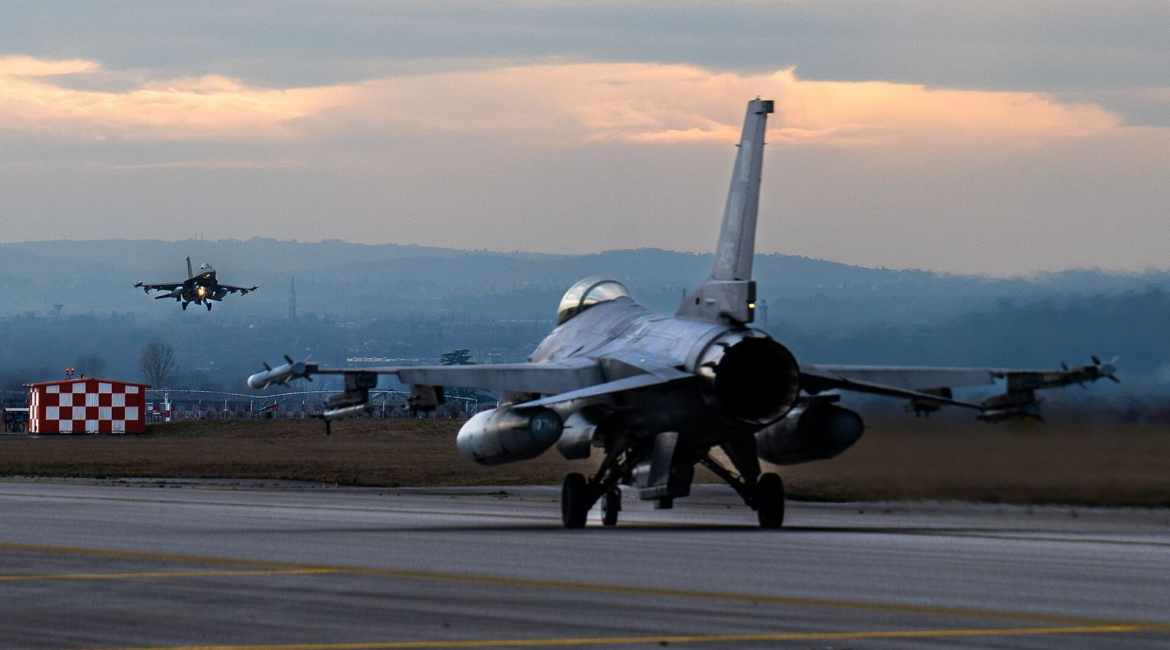
Featured image: U.S. Air Force F-16s land and taxi at Aviano Air Base, Italy, during Exercise Fighting Wyvern 25-01, March 11, 2025. U.S. Air Force photo by Airman 1st Class Zachary Jakel (public domain), via Wikimedia Commons.