
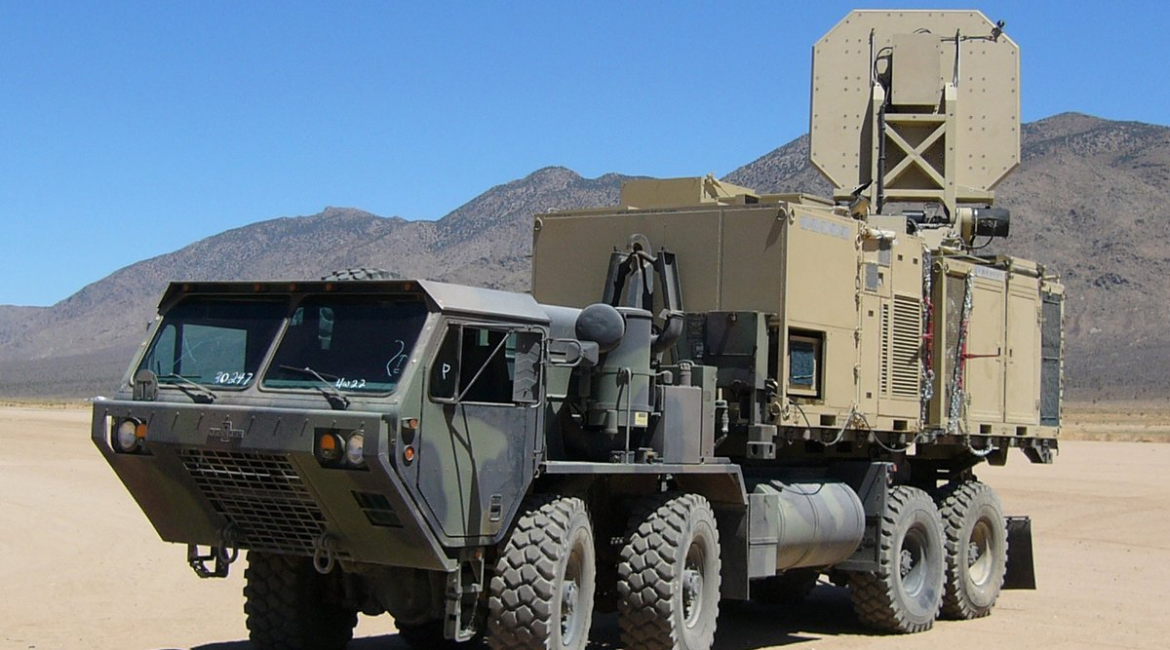
The Pentagon has lent the Department of Homeland Security a weapon most Americans know only from science fiction: a truck-mounted “heat ray” that can produce a burning sensation on a person’s skin from a little more than half a mile away. According to a memo signed last month by Defense Secretary Pete Hegseth and obtained by CNN, DHS may test the system and develop tactics to potentially use it at the southern border. U.S. Customs and Border Protection confirmed on Wednesday that it is reviewing the technology, Stars and Stripes reported.
Securing the border is a legitimate and necessary job of the federal government. But how the government uses force against human beings, and under what rules, is exactly the kind of question a constitutional republic must answer in the open. On that score, the public record so far comes up short.
What the Active Denial System is
The weapon’s official name is the Active Denial System, or ADS. CNN, citing the U.S. military, describes it as a nonlethal weapon that fires an invisible beam of electromagnetic waves that can reach a little more than half a mile. Military.com reports the beam uses 95 GHz millimeter-wave energy. Pentagon officials have compared the sensation to the blast of heat from opening a hot oven, and military officials say the “tingling effect” lasts 10 to 15 minutes while producing “an instinctive and irresistible urge to run from the effect.”
The technology is not new. Stars and Stripes reports that it grew out of Air Force Research Laboratory work beginning in the 1980s, that a prototype was first demonstrated in 2001, and that the Marine Corps and Air Force tested it in the early 2000s. In an October 2007 demonstration, Marines said that of more than 700 people exposed to the beam in testing and demonstrations, eight suffered burns and two needed medical attention. Military.com reports that during 2007 testing at Moody Air Force Base in Georgia, an airman suffered second-degree burns and was treated at a hospital.
It has also never been used for real. The military sent it to Afghanistan and brought it home in 2010 without using it in combat, Military.com reports, and considered it for crowd control at overseas detention facilities without employing it there. CNN reports that officials also considered deploying it during domestic unrest at the end of President Trump’s first term, during the protests over George Floyd’s death.
What the memo says, and does not say
According to CNN, the memo authorizes the “temporary loan” of one ADS unit for seven months starting in September, and says it “shall not be operated by DoW (Department of War) personnel.” DHS is solely responsible for “system employment, use and development of tactics, techniques and procedures,” and may ask to keep the system longer when the loan ends.
Barring military operators is the right instinct. As Military.com notes, federal law allows the defense secretary to make equipment available to civilian law enforcement, and keeping troops off the trigger tracks the laws that keep the armed forces out of direct domestic law enforcement. That separation is one of the oldest safeguards of American liberty.
But the memo leaves the most important questions unanswered. CNN reports that DHS’s request did not say where or how the weapon would be tested or how it might eventually be used. Military.com sums it up: no document made public so far explains where the system is, who would fire it, or under what rules of engagement. DHS regulations require officers to use only the objectively reasonable force necessary under the totality of the circumstances, but the loan language itself does not settle how the weapon could lawfully be used against people.
Hard questions from inside the agency
Some of the sharpest doubts come from border officials themselves. CNN reports that officials previously ran into hurdles over legality, use of force, effectiveness, and sovereignty, particularly if the beam reached people in Mexico who had not yet crossed. The chief concern was whether people could be harmed directly or indirectly. “Even if they’re chasing people back to the river, you don’t want them to go in and drown,” a former CBP official told CNN. “For the cost, for the training and for the policies you’re going to create, is the juice worth the squeeze?”
CNN reports that in 2018 CBP officials weighed using the system against migrants, but then-Homeland Security Secretary Kirstjen Nielsen rejected the idea. The El Centro sector in California evaluated the system several years ago when it was led by Rodney Scott, who is now CBP commissioner. And some Border Patrol agents have recently questioned whether they need it at all, given low border crossings and more personnel, a former CBP official told CNN.
For its part, CBP said it “is continually evaluating new technology, especially technology that can save lives while simultaneously enhancing national security effectiveness.”
A conservative standard for new force
Conservatives believe in a strong border and in a government that enforces its laws. We also believe that power, especially power over the human body, must be limited, defined, and accountable. Those commitments fit together. Here is what responsible use of a tool like this requires.
Written rules before any field use. DHS should publish the policy that governs the system: who may authorize it, against whom, at what range, for how long, and with what medical support on hand. If the rules cannot survive public scrutiny, the weapon should not be used.
Congressional oversight. Congress funds DHS and writes the laws it enforces. The relevant committees should be briefed on the loan, the test plan, and the legal analysis before the system is used on anyone. This is not a matter for a memo alone.
Respect for sovereignty and safety. A beam that can cross into Mexico raises diplomatic and legal questions the United States should resolve with its neighbor first. And a weapon designed to make people flee should never be pointed where flight means a river.
Equal protection for citizens. CNN’s reporting that officials once considered the system for domestic protests should concern every American. Any tool acquired for the border must come with firm limits that keep it from drifting into use against citizens exercising their rights.
A secure border built on clear law will last longer than one built on improvised force. If this technology truly saves lives and protects agents, DHS should be able to show the American people how, in writing, before it is ever switched on.
Sources
- CNN: Pentagon grants DHS permission to test heat ray weapon for potential use at border (Oct. 21, 2026)
- Military.com: DOD Memo Greenlights DHS Use of Military ‘Heat Ray’ at US-Mexico Border (Oct. 21, 2026)
- Stars and Stripes: Border Protection agency receives ‘nonlethal’ crowd control heat ray from Pentagon (Oct. 21, 2026)